POLYU SCHOOL OF DESIGN · SD2112 · WEEK 02 · LECTURE + WORKSHOP
Rules that make things.
Week 2 — machine A, p5.js, and a machine that writes rules.
POLYU SCHOOL OF DESIGN · SD2112 · WEEK 02 · LECTURE + WORKSHOP
Rules that make things.
Week 2 — machine A, p5.js, and a machine that writes rules.
SD2112 · WEEK 02
Today
01
Last week, in your words
02
Machine A: rules
03
Instructions as art
04
Rules make pictures
05
Rules that grow
06
p5.js: a sketchbook that runs
07
Specs, and prompts for coding
08
Exercise: one spec, one twist
SD2112 · AI IN DESIGN · WEEK 02
02

01
Last week, in your words
the cloud · the worries · the cups
SD2112 · AI IN DESIGN · WEEK 02
03
01 · LOGISTICS · MULTIPLE CHOICE
Before we start: what do you have with you?
A
A laptop
B
A tablet
C
Only a phone
D
Nothing today
SD2112 · AI IN DESIGN · WEEK 02
04
01 · YOUR WORRIES · AND THE WEEK THAT ANSWERS THEM
You worried about five things.
CHEATING
Allowed, disclosed, yours.
The rule from week 1 stands: use any model, say which one, and answer for what it made. Week 11 is about authorship: who made Belamy?
LOSING SKILLS
Five small makes.
Weeks 2 to 6: one thing a week where your hand stays on the rule. Today is the first.
COPYRIGHT
Week 11.
Datasets, LoRAs, the Thaler cases, and what a court calls transformative.
JOBS
Weeks 8 and 12.
The designer's turn: what is left for you when the model makes the artefact. Curator, briefer, guardrail-setter.
BEING LIED TO
Weeks 4 and 9.
Hallucination and sycophancy in week 4. Bias, data and privacy in week 9.
SD2112 · AI IN DESIGN · WEEK 02
05
01 · THE CUPS · THE WALL
Your prompts were rules. The model had the examples.
A hundred first cups: white, ceramic, a handle. Nobody typed "handle". Your prompt was a rule, and the model pulled every cup back to its average. Today we look at the rules side on its own.
Machine A: write the rule. Machine B: show the examples. This week is the left half; next week the right.
SD2112 · AI IN DESIGN · WEEK 02
06
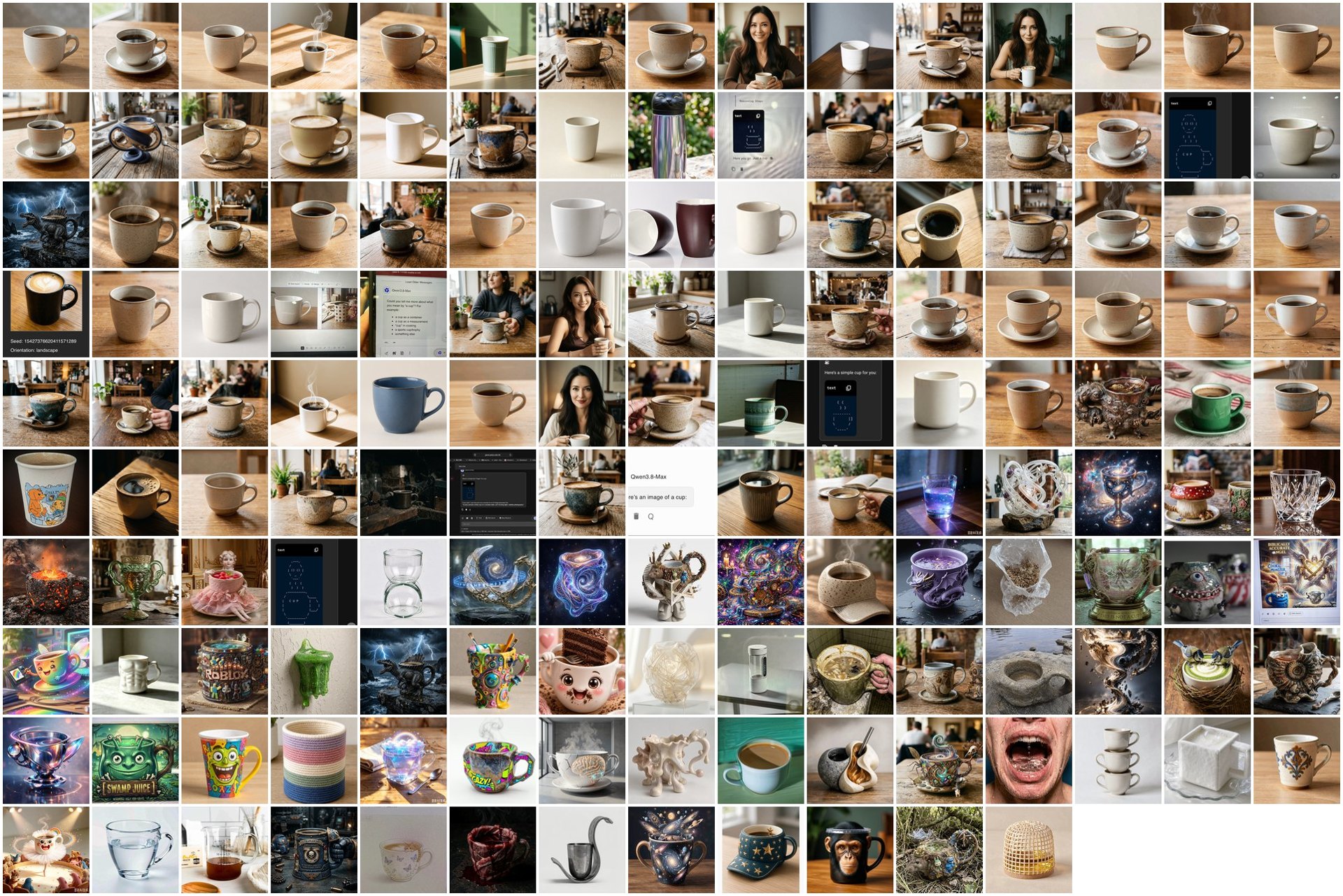
01 · THE WALL · 87 FIRST CUPS, THEN THE 60 THAT SHIPPED
Every cup the room uploaded last week. The top rows are the average: white, ceramic, a handle, a wooden table, and nobody asked for any of it. The bottom rows are what a prompt with a rule in it does.
01 · THE SEMESTER
Where we are
1 · What is AI?
Week 1
Two ways to teach a machine
Week 2
Rules that make things: code, chance, generative art
Week 3
Learning from examples: concepts, neurons, Move 37
2 · AI for the creative process
Week 4
Language machines: LLMs, prompts, agents
Week 5
Image machines: diffusion, CLIP, mediation
Week 6
Sound machines: music, voice, spectrograms
Mid-term
Week 7
Mid-term quiz · project pitches · teams · reflection due
3 · AI inside products
Week 8
AI as design material: use vs incorporate
Week 9
Data, bias and privacy
Week 10
Recommendation systems and the feed
4 · The designer's turn
Week 11
Curating outputs and datasets · authorship
Week 12
Language as an interface: chatbots and agents
Showcase
Week 13
Poster fair · final quiz
SD2112 · AI IN DESIGN · WEEK 02
08
02
Machine A
symbolic AI · 1956 – today · if this, then that
SD2112 · AI IN DESIGN · WEEK 02
09
02 · A RULE
If this, then that. Nothing else.
A rule is a condition and a consequence. A computer is a machine that follows rules exactly, forever, without judgement (Turing, 1936). Newell and Simon, 1976: intelligence is symbols plus search, which means rules applied to rules.
Symbolic AI: knowledge written down as rules, applied by a program. Exact, explainable, and it has never heard of the Tulip chair.
SD2112 · AI IN DESIGN · WEEK 02
10
02 · IMMANUEL KANT · 1781 · ANALYTIC, SYNTHETIC
Two kinds of true.
Kant, 1781: an analytic judgement is true by the meaning of its words. "A brother is a male sibling." Nothing new is learned.
A synthetic one adds what the words did not contain. "Kevin and Bob are brothers." You have to go and look.
Machine A is analytic through and through: it unpacks what its rules already contain, faster than we can, and nothing else.
Analytic or synthetic? All bachelors are unmarried. All bachelors are wealthy. All mammals are animals. If it is cloudy it might rain. 2 + 2 = 4.
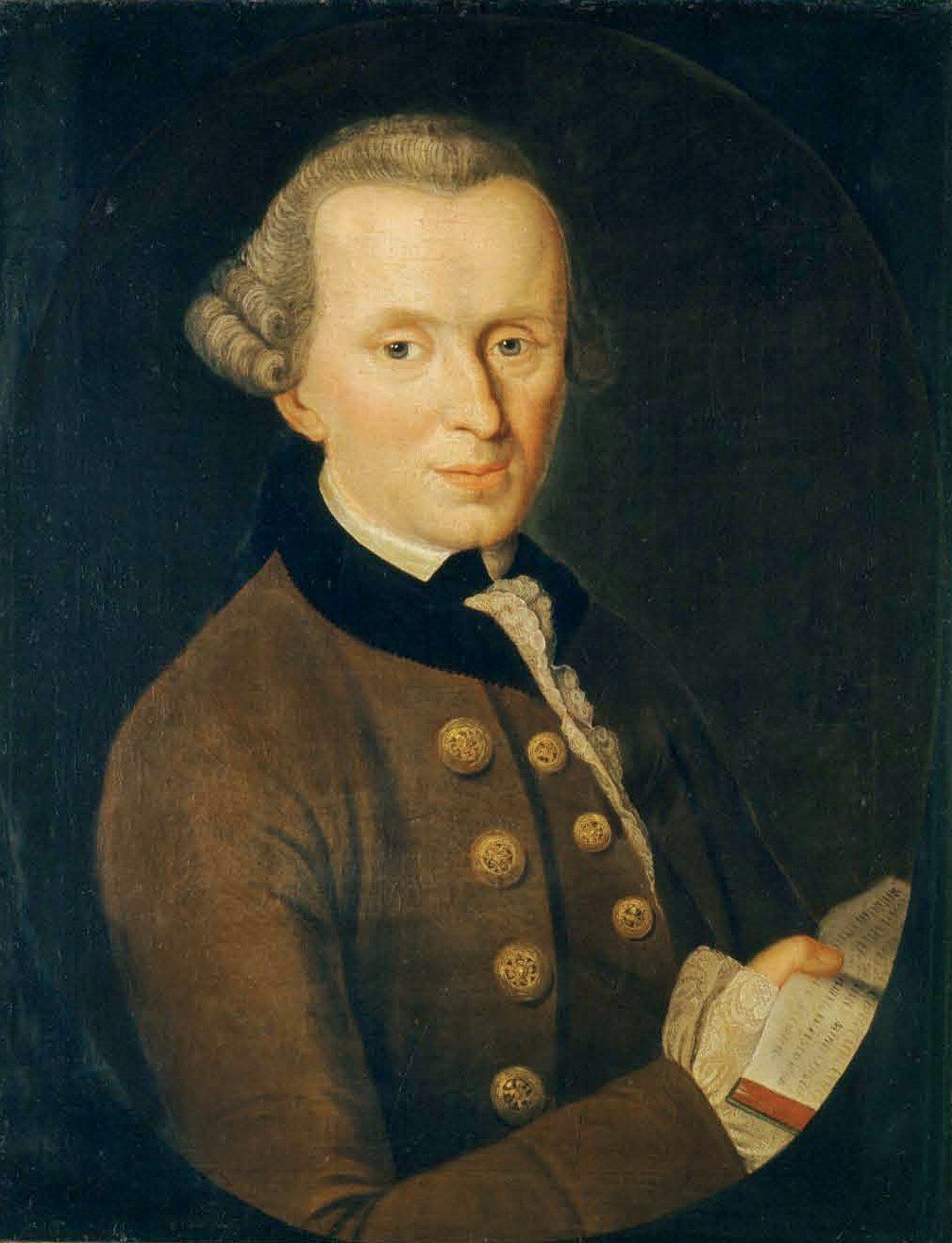
Immanuel Kant, by Johann Gottlieb Becker, 1768. Public domain, Wikimedia Commons.
SD2112 · AI IN DESIGN · WEEK 02
11
02 · ALAN TURING · 1950 · THE IMITATION GAME
Can machines think? Ask a better question.
"I propose to consider the question, Can machines think?" Turing, 1950. Thinking is too vague to test, so he swaps the question for a game.
An interrogator types questions to two hidden players, a person and a machine. If the interrogator cannot tell which is which, the machine has done well.
The test looks at behaviour, never at the insides. It is our week-1 definition of intelligence turned into an experiment.
ELIZA, sixteen years later, is the first program people mistook for a person. Two slides on, its insides.
A. M. Turing, "Computing Machinery and Intelligence", Mind 59 (236), October 1950. doi:10.1093/mind/LIX.236.433
SD2112 · AI IN DESIGN · WEEK 02
12
02 · SIXTY YEARS OF MACHINE A
Rules were the first AI.
1956 · DARTMOUTH
AI gets its name.
McCarthy, Minsky, Shannon and Rochester spend a summer on "making machines use language, form abstractions and concepts". Newell and Simon bring the Logic Theorist: a program that proves theorems.
1966 · ELIZA
Two hundred rules pass for a therapist.
Weizenbaum's script finds a keyword and turns the sentence around. "I am sad" becomes "How long have you been sad?" His secretary asked him to leave the room so she could talk to it in private.
1972 – 1986 · EXPERT SYSTEMS
Rules run a business. Then the winter.
MYCIN: about 600 rules diagnose blood infections as well as Stanford's specialists. XCON: 10,000 rules configure every computer DEC sells. Then it ends: someone has to write, and maintain, every single rule.
SD2112 · AI IN DESIGN · WEEK 02
13
02 · ELIZA · 1966 · ELIZABOT.JS BY N. LANDSTEINER, 2005
A rule that feels like a person.
// ELIZA, 1966: Weizenbaum's DOCTOR script, running as he wrote it.
// A rule: a keyword, its rank, then for each shape of sentence the
// answers. * matches anything; (2) says what the second * matched.
const rules = [
  ["remember", 5, [
    ["* i remember *", ["Do you often think of (2) ?",
                        "Why do you remember (2) just now ?"]],
    ["* do you remember *", ["Did you think I would forget (2) ?",
                             "What about (2) ?"]]]],
  ["computer", 50, [
    ["*", ["Do computers worry you ?",
           "Why do you mention computers ?"]]]],
  ["xnone", 0, [                      // when nothing else matches
    ["*", ["I'm not sure I understand you fully.",
           "Please go on."]]]],
];
function setup() {
  noCanvas();
  elizaKeywords.unshift(...rules);   // yours go first
  chat(new ElizaBot());             // the screen on the right
}
Weizenbaum's script, whole: the strongest keyword wins, the sentence is taken apart and put back in an answer. Talk to it, add a rule, press Run · edit it live.
SD2112 · AI IN DESIGN · WEEK 02
14
02 · THE DEAL
Exact. Explainable. Brittle.
EXACT
Same input, same output.
A rule does the same thing every time. Even chance can be made repeatable: give the die a seed and the same picture comes back, on any machine, forever.
EXPLAINABLE
You can point at the line that decided.
Every output has a reason you can read. When a rule-based product does something strange, you can find out why. Machine B cannot say why. Next week.
BRITTLE
Nothing outside the rule can happen.
The definition does not know beanbags exist. Every new case needs a new rule, written by hand. That bottleneck ended the expert-systems boom.
SD2112 · AI IN DESIGN · WEEK 02
15
02 · YOU ALREADY WRITE RULES
Every designer already writes machine A.
THE GRID
Snap to 8 px.
Columns, gutters, a spacing scale: a rule you set once, and every screen obeys it.
THE BREAKPOINT
Narrower than 600 px? One column.
An if-then you have written, in words, for a developer to execute.
THE SYSTEM
One button, every state.
Tokens, variants, auto layout: a rule-based machine that makes every button in the product.
THE SPEC
Redlines, briefs, handoffs.
A rule written in words for a human to execute. Today you write one for a machine, and then for a machine that writes machines.
SD2112 · AI IN DESIGN · WEEK 02
16
02 · QUESTION · SHORT ANSWER · Your answers
Write a rule for drawing a house.
One sentence. A stranger who has never seen a house must be able to follow it.
SD2112 · AI IN DESIGN · WEEK 02
17
03
Instructions as art
1959 – 1971 · scores, events, wall drawings
SD2112 · AI IN DESIGN · WEEK 02
18
03 · LA MONTE YOUNG · COMPOSITION 1960 #10 · TO BOB MORRIS
Draw a straight line and follow it.
SD2112 · AI IN DESIGN · WEEK 02
19
03 · THE EVENT SCORE
The score is the work. Anyone can execute it.
GEORGE BRECHT · 1959
Drip Music
"A source of dripping water and an empty vessel are arranged so that the water falls into the vessel." Performed with a ladder and a jug, with a tap, with a pipette. The rule survives every execution.
YOKO ONO · 1964
Grapefruit
A book of instructions. "Painting to be stepped on: leave a piece of canvas or finished painting on the floor or in the street." Some cannot be executed at all. They are still pieces.
JOHN CAGE · 1951 – 1960
Chance inside rules
Music of Changes: every note decided by coin tosses on the I Ching. Water Walk: a score of timed actions with a bathtub, performed on live television. The rule decides where chance is allowed in.
SD2112 · AI IN DESIGN · WEEK 02
20
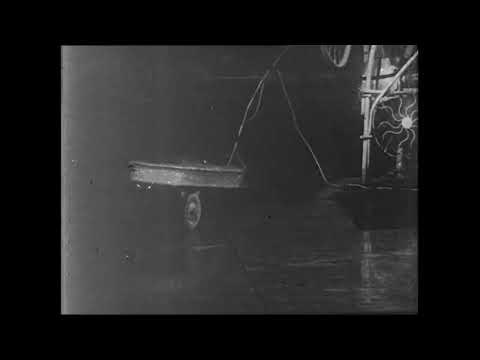
03 · TINGUELY · MOMA GARDEN · 17 MARCH 1960
A machine whose rule was to destroy itself.
Homage to New York: bicycle wheels, motors, a piano, a weather balloon, built in the museum garden. Switched on, it was meant to end itself in about half an hour.
It failed properly: the fire brigade put it out. The rule ran; the execution surprised its author.
On the playlist with Cage, Kaprow and the Illiac Suite: watch the four before week 3.
SD2112 · AI IN DESIGN · WEEK 02
21
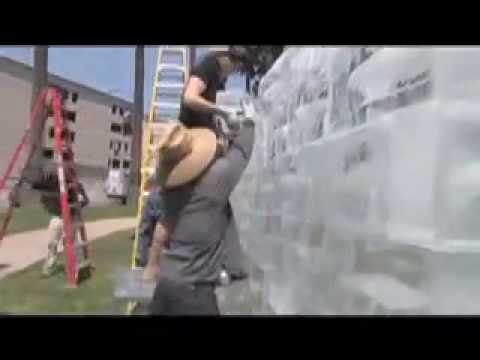
03 · KAPROW · 1967 · PASADENA 2008 · BERLIN 2015
Instructions executed by strangers, decades later.
Fluids, 1967. The whole score: "During three days, about twenty rectangular enclosures of ice blocks (measuring about 30 feet long, 10 wide and 8 high) are built throughout the city. Their walls are unbroken. They are left to melt."
Kaprow called every re-execution a reinvention. Each one is the piece.
The spec is the artwork. The execution is delegated, and it is still the work.
SD2112 · AI IN DESIGN · WEEK 02
22
"The idea becomes a machine that makes the art."
Sol LeWitt, Paragraphs on Conceptual Art, Artforum, June 1967
SD2112 · AI IN DESIGN · WEEK 02
23
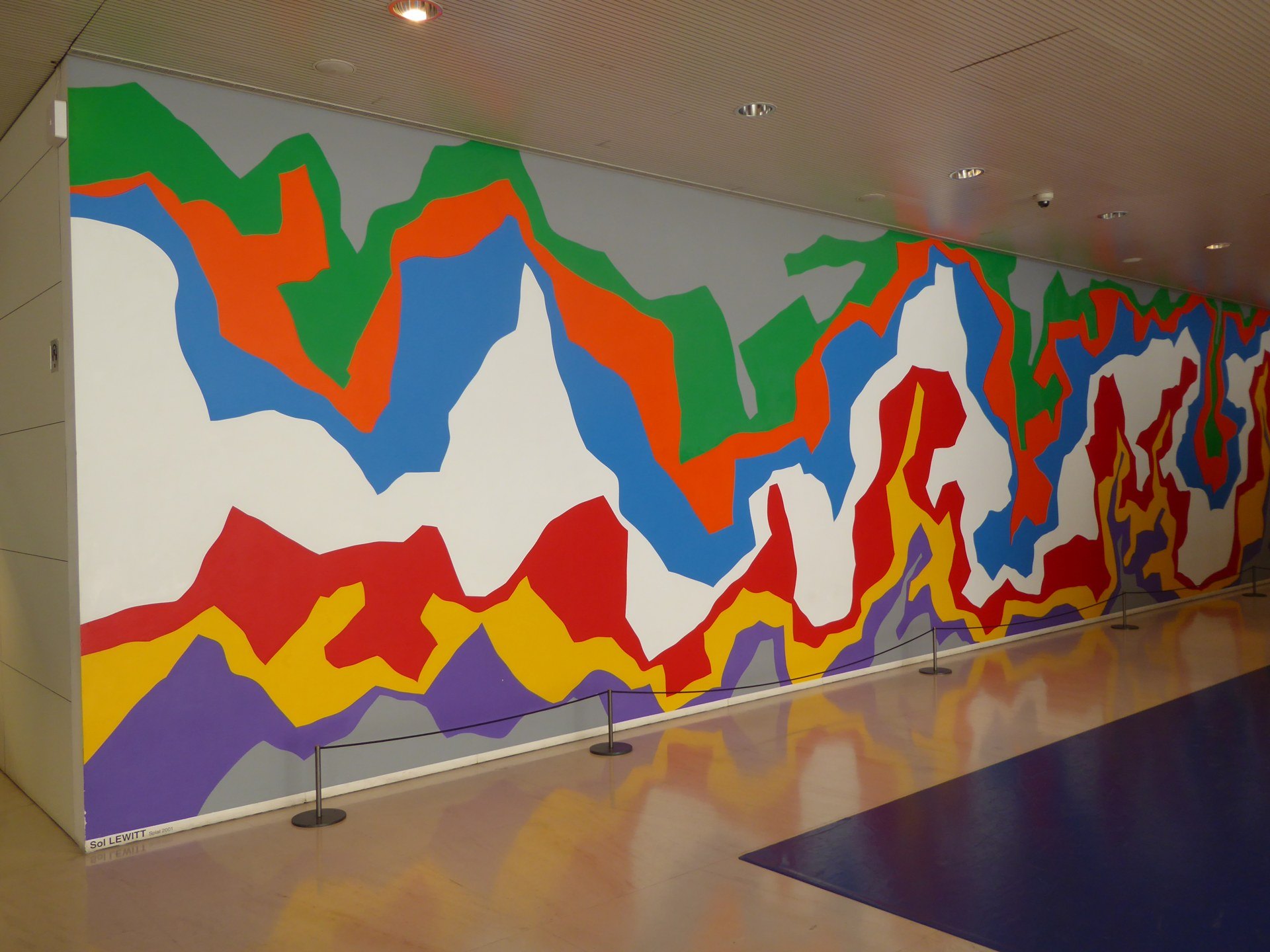
03 · SOL LEWITT · SPLAT · 2001 · CAIXAFORUM BARCELONA
A wall drawing: LeWitt wrote the instruction and signed a certificate; assistants drew it on this wall, and can draw it again on any other. Photo: Ardfern, 2014, CC BY-SA 3.0, Wikimedia Commons.
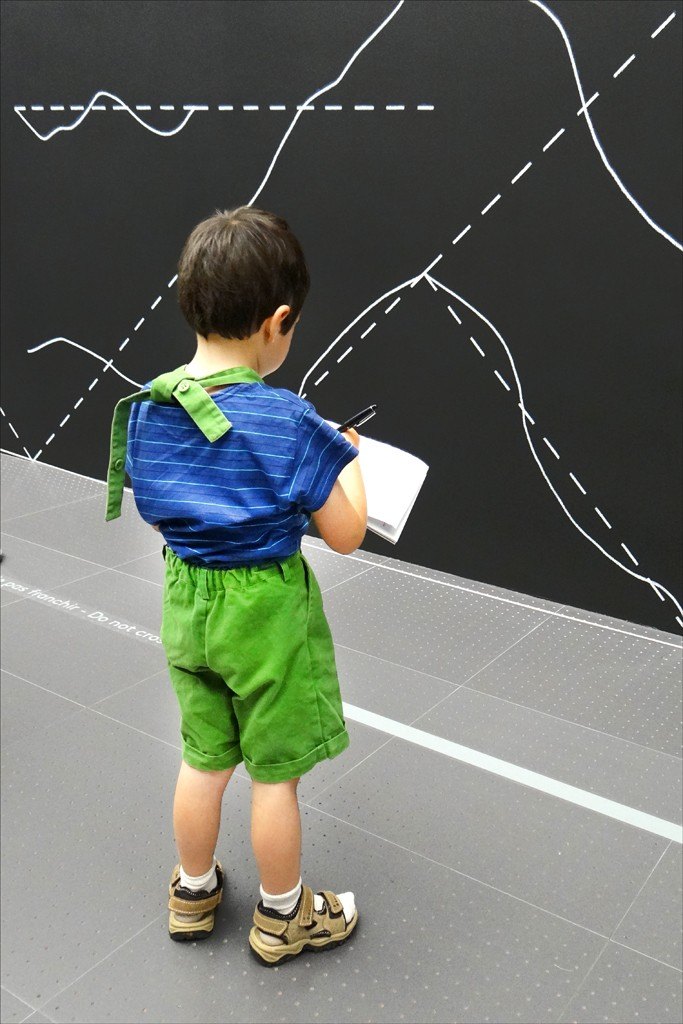
03 · SOL LEWITT · WALL DRAWINGS · CENTRE POMPIDOU-METZ · 2012
Lines on a black wall, drawn by hand from a written rule five years after his death: the drawing needs the rule, not the artist. Photo: Jean-Pierre Dalbéra, CC BY 2.0, Wikimedia Commons.
03 · SOL LEWITT · WALL DRAWING 118 · 1971 · THE WHOLE WORK
On a wall surface, any continuous stretch of wall, using a hard pencil, place fifty points at random. The points should be evenly distributed over the area of the wall. All of the points should be connected by straight lines.
SD2112 · AI IN DESIGN · WEEK 02
26
03 · WALL DRAWING 118 · EXECUTED BY A PYTHON SCRIPT, TODAY
Fifty points. 1,225 lines. Any wall.
Every execution is the work. The drafters decide what the words left open: the pencil, the wall, what "random" means. A museum buys the instructions and a certificate; the drawing is made again, by other hands, each time it is shown.
The same forty-five words, executed by a program instead of five art students. LeWitt: "Each person draws a line differently and each person understands words differently."
SD2112 · AI IN DESIGN · WEEK 02
27
03 · VERA MOLNÁR · 1959 – 1976
She executed her algorithms by hand for nine years.
Machine imaginaire: from 1959 Molnár wrote procedures, a grid, a rule, a small dose of chance, and executed them herself, on paper, step by step, before she had access to a computer.
1968: her first plotter. The rule did not change. The executor did.
(Dés)ordres, 1974: nested squares in a grid, and a small chance that any corner is nudged. Find the disorder.
A spec written for a machine that does not exist yet is still a spec.
After Molnár: nested squares, every corner nudged with a small probability. Our execution, her rule.
SD2112 · AI IN DESIGN · WEEK 02
28
04
Rules make pictures
Stuttgart 1965 · Bense · Nees · Nake · the plotter
SD2112 · AI IN DESIGN · WEEK 02
29
04 · MAX BENSE · INFORMATION AESTHETICS
Beauty, measured. Art, generated.
Birkhoff, 1933: aesthetic measure = order ÷ complexity. Bense, Stuttgart, 1950s: if beauty is information, it can be programmed.
February 1965: Georg Nees shows plotter drawings in Bense's seminar gallery. Bense calls it artificial art. The first computer art exhibition, anywhere.
A painter asks Nees whether the machine could draw the way he does. Nees: "Yes, if you tell me how you draw."
November 1965: Nake and Nees, Galerie Niedlich. This one hangs in the V&A.
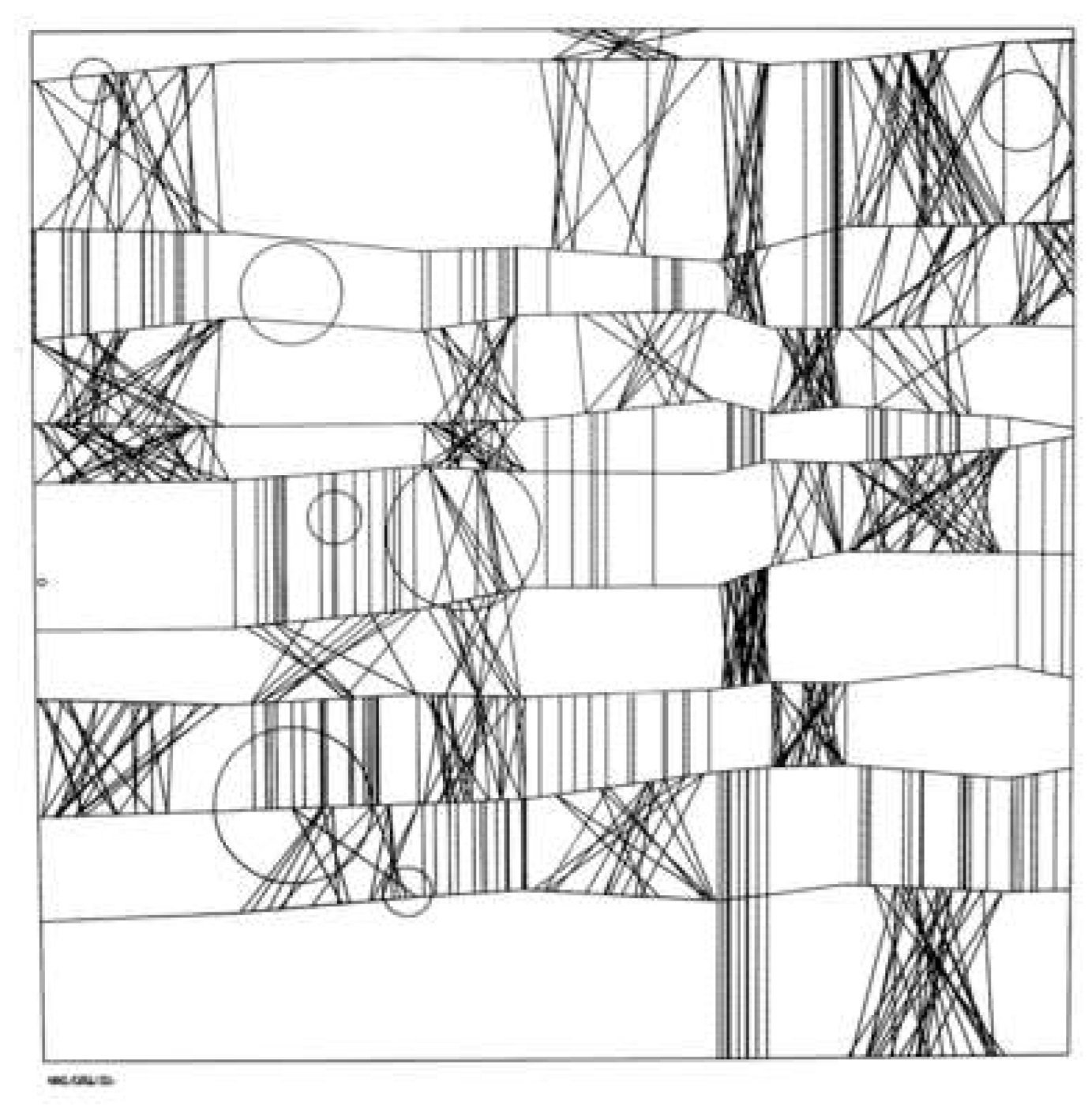
Frieder Nake, Hommage à Paul Klee 13/9/65 Nr.2, 1965. Zuse Graphomat Z64 plotter, programmed in ALGOL.
SD2112 · AI IN DESIGN · WEEK 02
30
04 · GEORG NEES · SCHOTTER · c. 1968
One rule. One random number.
Twelve columns, twenty-two rows of squares. Each square is moved and turned by a random amount, and the amount grows with the row.
Row 0: a perfect grid. Row 21: gravel. Schotter means gravel.
The rule decides everything except two numbers per square. Chance is kept on a leash; the picture is order turning into disorder.
The sliders are the rule's two numbers: how much disorder, how many rows.
After Nees: our execution of his rule. Siemens 4004, ALGOL, Zuse Graphomat; the original print is 28 × 22 cm.
SD2112 · AI IN DESIGN · WEEK 02
31
04 · 1982 · 10 PRINT CHR$(205.5+RND(1)); : GOTO 10
One coin toss. Two states. No memory.
const s = 40;                    // the cell: 40 px
let heads;                       // the coin: a slider
function setup() {
  createCanvas(800, 480); noLoop();
  heads = createSlider(0, 1, 0.5, 0.05, 'heads');
}
function draw() {
  background(255); stroke(0); strokeWeight(3);
  for (let y = 0; y < height; y += s)   // row by row
    for (let x = 0; x < width; x += s) { // cell by cell
      if (random() < heads.value())   // the coin toss
        line(x, y, x + s, y + s);     // heads: ╲
      else
        line(x + s, y, x, y + s);     // tails: ╱
    }
}
One line of Commodore 64 BASIC, 1982: one of two diagonals, chosen by a coin toss, forever. Every cell is a fresh toss; none knows about the others · edit it live.
SD2112 · AI IN DESIGN · WEEK 02
32
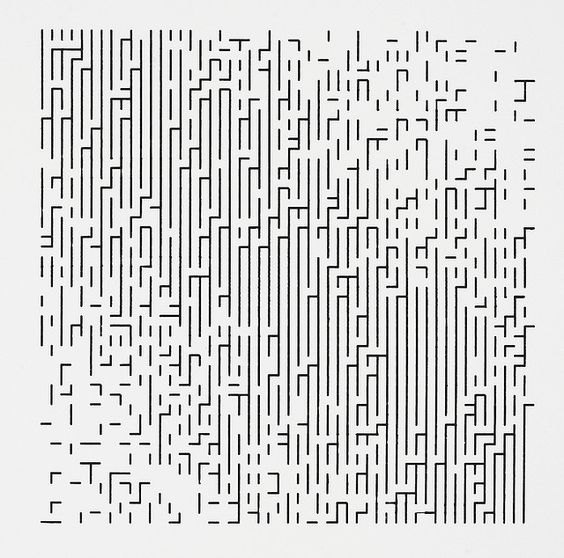
04 · FRIEDER NAKE · WALK-THROUGH-RASTER · SERIES 2, 1–4 · 1966
Look first. What repeats? What never happens? Four prints from one program: ALGOL 60 on a Zuse Graphomat Z64. Victoria and Albert Museum, E.955-2008.
04 · WALK-THROUGH-RASTER · THE RULE IN FOUR STEPS
Four states. The cell above decides.
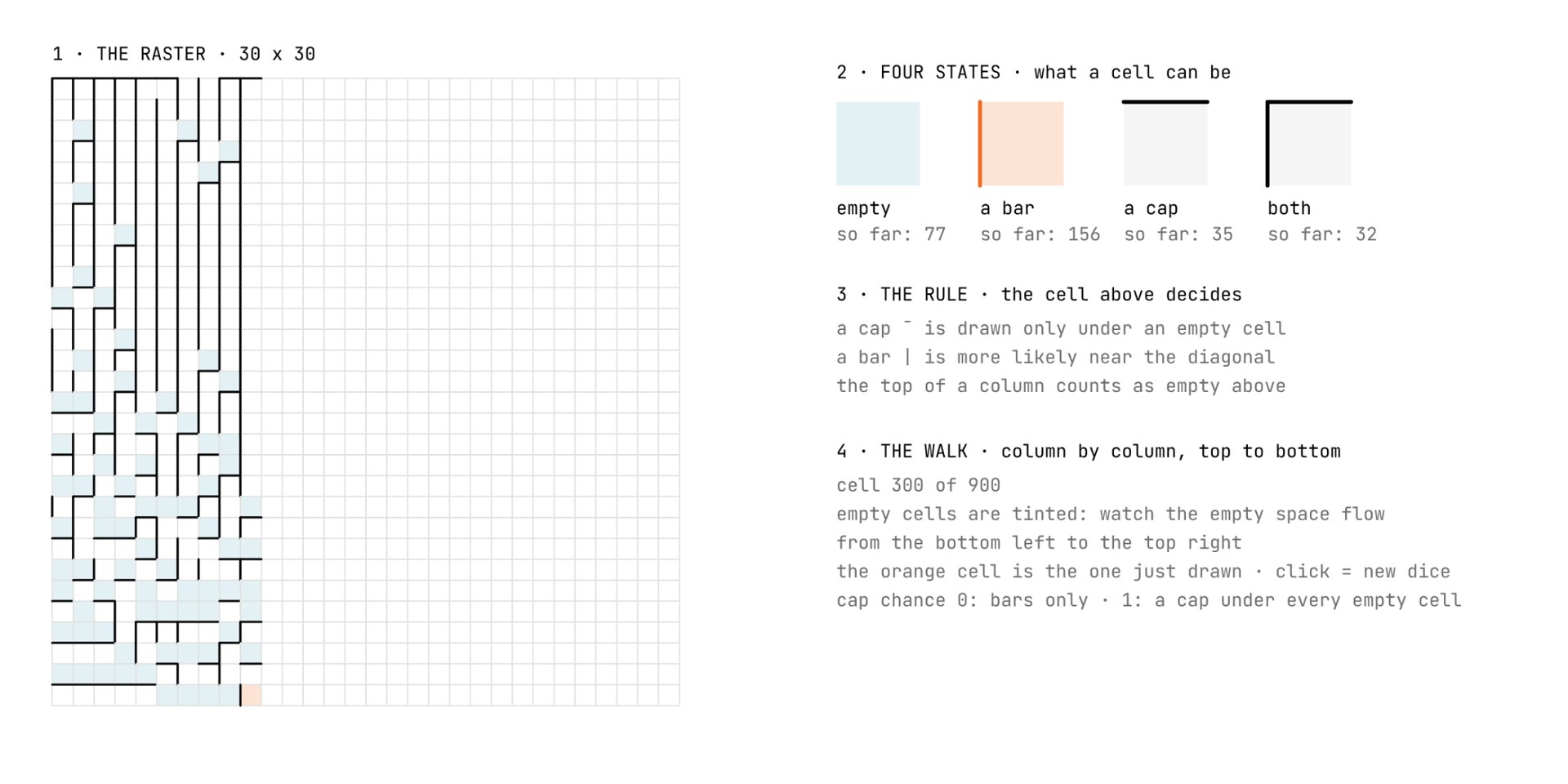
A grid, drawn column by column, top to bottom. Every cell is one of four things: empty, a bar, a cap, or both (10 PRINT had two). Two rules decide: a bar is more likely near the diagonal, and a cap can only be drawn under an empty cell, so a cell remembers one thing about the one above it. The empty space flows up and to the right, and every field of caps has gaps.
Nake, Walk-Through-Raster, series 2.1–4, 1966. Our reading of his rule: two yes/no decisions per cell, and one fact carried from the cell above.
SD2112 · AI IN DESIGN · WEEK 02
34
04 · WALK-THROUGH-RASTER · WATCH THE WALK
The raster fills up, column by column.
Left: the raster filling up, top to bottom, then the next column. Empty cells are tinted: watch the empty space flow up and to the right. Right: the four states and how many of each so far. Drag the cap chance: at 0 only bars; at 1, a cap under every empty cell.
SD2112 · AI IN DESIGN · WEEK 02
35
04 · WALK-THROUGH-RASTER · THE RULE, IN TWENTY LINES
Two loops, two decisions, one fact carried down.
const n = 30;                        // the raster: 30 x 30
let capChance;                       // a slider
function setup() {
  createCanvas(600, 600); noLoop();
  capChance = createSlider(0, 1, 0.8, 0.05, 'cap chance');
}
function draw() {
  background(255); stroke(0); strokeWeight(1.6);
  let g = width / (n + 2);
  for (let w = 0; w < n; w++) {      // column by column
    let above = false;               // was the cell above empty?
    for (let h = 0; h < n; h++) {    // top to bottom
      let x = (w + 1) * g, y = (h + 1) * g;
      let bar = random(n - 1) >= abs(w - h);  // the diagonal
      let cap = h > 0 && above && random() < capChance.value();
      if (bar) line(x, y, x, y + g);            // a bar: |
      if (cap) line(x, y, x + g, y);            // a cap: ¯
      above = !bar && !cap;          // what the cell below sees
    }
  }
}
Our execution, after Nake. "above" carries one fact from cell to cell: was the cell above empty? That line is the whole texture · edit it live.
SD2112 · AI IN DESIGN · WEEK 02
36
04 · HILLER & ISAACSON · UNIVERSITY OF ILLINOIS · 1957
A computer writes a string quartet.
The Illiac Suite: the ILLIAC makes random notes and keeps the ones that pass the rules of counterpoint. Generate and test: the oldest move in symbolic AI.
The fourth movement chooses each note from the one before it: a chain. Nake's cells, nine years later, each decided by the one above.
On the playlist. Sixteen minutes, four experiments, one machine.
SD2112 · AI IN DESIGN · WEEK 02
37
05
Rules that grow
fractals · L-systems · parameters
SD2112 · AI IN DESIGN · WEEK 02
38
05 · HELGE VON KOCH · 1904 · A FRACTAL
Replace every line with four. Then do it again.
One rule, applied to its own output: cut a line in three, turn the middle third into a peak, and do the same to each of the four new lines. Four times: 256 lines. Forever: a curve of infinite length that fits in your hand, the same at every scale. Its dimension is log 4 ÷ log 3 = 1.26: more than a line, less than a surface.
Mandelbrot, The Fractal Geometry of Nature, 1982: coastlines, clouds and ferns are rules like this one. Nobody could draw the twentieth generation before computers.
SD2112 · AI IN DESIGN · WEEK 02
39
05 · KOCH · IN P5.JS
A rule that calls itself.
let times;                          // how many times
function setup() {
  createCanvas(900, 300); noLoop();
  times = createSlider(0, 6, 4, 1, 'times');
}
function koch(x1, y1, x2, y2, n) {      // the rule
  if (n == 0) { line(x1, y1, x2, y2); return; }
  let dx = (x2 - x1) / 3, dy = (y2 - y1) / 3;
  let ax = x1 + dx, ay = y1 + dy;       // one third
  let bx = x1 + 2 * dx, by = y1 + 2 * dy;  // two thirds
  let px = ax + dx / 2 + dy * .866;     // the peak: the
  let py = ay + dy / 2 - dx * .866;     // middle, turned 60°
  koch(x1, y1, ax, ay, n - 1);          // again, on each
  koch(ax, ay, px, py, n - 1);          // of the four
  koch(px, py, bx, by, n - 1);
  koch(bx, by, x2, y2, n - 1);
}
function draw() {
  background(255); stroke(0);
  koch(40, 240, 860, 240, times.value());  // n times
}
koch() draws a line, or replaces it with four shorter koch()s. The slider is how many times; it plays by itself until you touch it. Try turning 60° into 90° · edit it live.
SD2112 · AI IN DESIGN · WEEK 02
40
05 · BENOÎT MANDELBROT · 1980 · THE SAME RULE AT EVERY SCALE
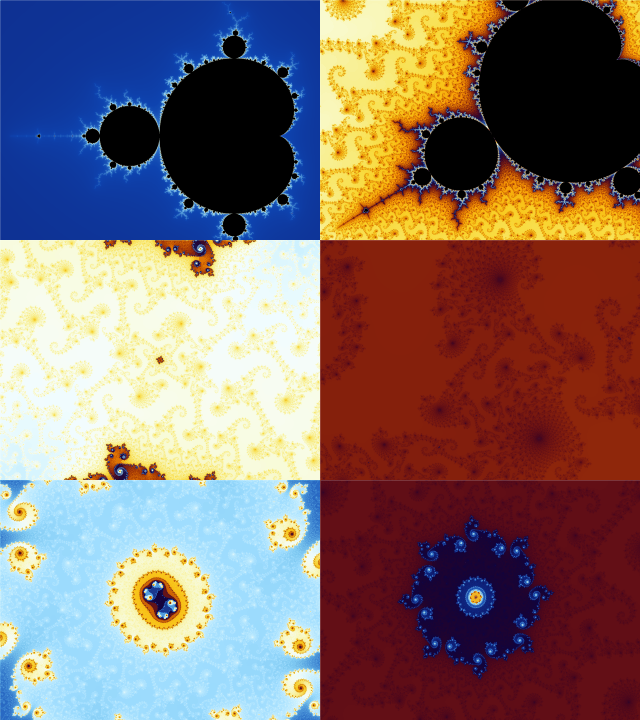
A zoom into the Mandelbrot set. One rule per point, z → z² + c, and a colour for how long it holds. Nobody had seen this before a computer drew it. Animation: Wikimedia Commons, public domain.
05 · MANDELBROT · IN P5.JS
One rule per pixel. Count how long it holds.
let steps;                          // how long we wait: a slider
let cx = -0.6, cy = 0, w = 3;       // the window: centre, width
function setup() {
  createCanvas(600, 400); pixelDensity(1); noLoop();
  steps = createSlider(10, 400, 60, 10, 'steps');
}
function draw() {
  let n = steps.value(); loadPixels();
  for (let px = 0; px < width; px++)
    for (let py = 0; py < height; py++) {
      let a = cx + (px - width / 2) * w / width;   // the point c
      let b = cy + (py - height / 2) * w / width;
      let x = 0, y = 0, k = 0;                     // z starts at 0
      while (x * x + y * y < 4 && k < n) {         // z = z² + c
        let t = x * x - y * y + a; y = 2 * x * y + b; x = t; k++;
      }
      let v = k == n ? 0 : 255 * sqrt(k / n);   // how soon it left
      let i = 4 * (px + py * width);
      pixels[i] = v * .3; pixels[i+1] = v * .6; pixels[i+2] = v;
      pixels[i+3] = 255;
    }
  updatePixels();
}
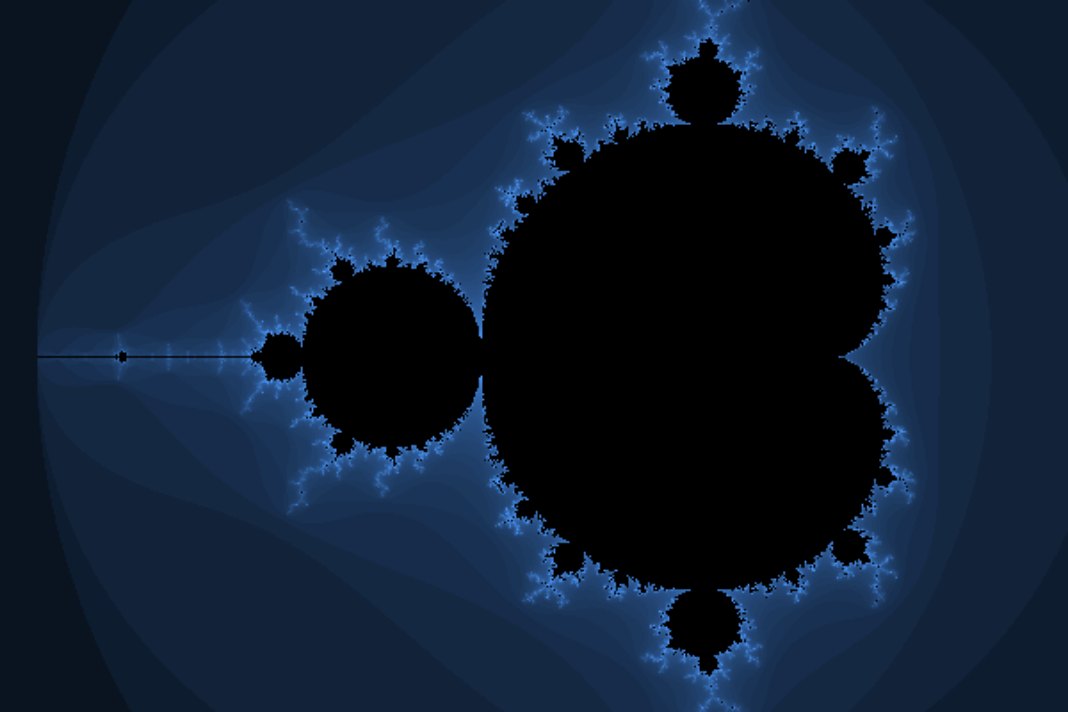
For every pixel, c is the point and z starts at 0: z = z² + c, again and again. Black: it never leaves. Blue: how soon it left. Click to zoom in, twice as close each time · edit it live.
SD2112 · AI IN DESIGN · WEEK 02
42
05 · LINDENMAYER · 1968
The same trick grows a plant.
Rewrite every F with the rule, then rewrite the result, and again: four generations from one line. Lindenmayer, a biologist, wrote it for algae. The brackets are branches.
F → F[+F]F[-F]F, turn 25.7°. Lindenmayer 1968; Prusinkiewicz & Lindenmayer, The Algorithmic Beauty of Plants, 1990.
SD2112 · AI IN DESIGN · WEEK 02
43
05 · PARAMETRIC DESIGN
Machine A, with sliders.
A rule with numbers left open is a design space. Change a number, get a design; every one obeys the rule.
Grasshopper, 2007: architecture as a graph of rules. A tower is a rule and a hundred numbers.
The MIT Media Lab identity, 2011: one algorithm, forty thousand logos, one per person.
Nervous System, Kinematics dress, 2014: a rule folds itself around a body.
The twelve chairs from week 1 are the same idea: chair(seat, back, angle, legs).
Week 1: one function, twelve chairs. Parametric design is a rule you can ship.
SD2112 · AI IN DESIGN · WEEK 02
44
05 · VARIABLE FONTS · 2016
One font, one number.
A letter is a rule with a parameter. Type designers have written machine A for a century: hinting, kerning, optical sizes. A variable font puts the number in your hands. This is Inter, the typeface of these slides, along its weight axis.
Inter Variable, wght 100 to 900. OpenType 1.8, 2016: Adobe, Apple, Google and Microsoft, together for once.
SD2112 · AI IN DESIGN · WEEK 02
45
05 · WHERE WE ARE
A rule is a design. The execution can be delegated.
SD2112 · AI IN DESIGN · WEEK 02
46
AFTER THE BREAK · P5.JS · THEN A MACHINE THAT WRITES RULES
Break. Ten minutes.
SD2112 · AI IN DESIGN · WEEK 02
47
06
p5.js
a sketchbook that runs · inside these slides
SD2112 · AI IN DESIGN · WEEK 02
48
06 · PROCESSING → P5.JS
Code as a sketchbook.
1999: John Maeda's Design By Numbers at the MIT Media Lab: a language small enough for designers.
2001: Casey Reas and Ben Fry, Maeda's students, make Processing, "a software sketchbook".
2013: Lauren McCarthy starts p5.js: Processing for the browser. Nothing to install: today it runs inside these slides.
Why it is here: the whole rule fits on one screen, and the picture is instant.
Ten points at random, all connected: twenty lines of p5.js. Next slide.
SD2112 · AI IN DESIGN · WEEK 02
49
06 · ANATOMY
setup() runs once. draw() runs the rule.
let pts = [];                        // the points
function setup() {
  createCanvas(600, 600);
  noLoop();                          // draw once
  roll();
}
function roll() {                    // the rule: ten points
  pts = [];
  for (let i = 0; i < 10; i++) {
    pts.push([random(600), random(600)]);    // chance
  }
}
function draw() {
  background(255); stroke(0);
  for (let a of pts) {               // every pair
    for (let b of pts) {
      line(a[0], a[1], b[0], b[1]);
    }
  }
  fill(0); for (let p of pts) circle(p[0], p[1], 6);
}
(0,0) is the top-left corner; y grows downwards; random(600) is a number between 0 and 600. Change 10 to 30, press Run. Then one 600 to 200, and see what breaks · edit it live.
SD2112 · AI IN DESIGN · WEEK 02
50
06 · RANDOM() · RANDOMSEED()
Same rule, three seeds.
random(600) is a number between 0 and 600, different every run. randomSeed(1) loads the die: the same picture every run, on every machine. Where you call random() is where the rule lets go; everything else is the rule.
Three runs of the ten-point sketch with randomSeed(1), (2) and (3). Change the seed, keep the rule: a new picture that is still yours.
SD2112 · AI IN DESIGN · WEEK 02
51
06 · SCHOTTER · IN P5.JS
A grid is two loops. Disorder is one number.
const cols = 12, rows = 22, s = 30;  // Nees's numbers
let disorder, seed = 1968;           // the one number: a slider
function setup() {
  createCanvas(400, 700); noLoop();
  disorder = createSlider(0, 2, 1, 0.05, 'disorder');
}
function draw() {
  background(255); noFill(); stroke(0);
  randomSeed(seed);                  // the same dice every time
  for (let r = 0; r < rows; r++) {   // rows
    let k = r / (rows - 1) * disorder.value();
    let d = k * s / 2, a = k * PI / 4;  // shift, turn
    for (let c = 0; c < cols; c++) { // columns
      push();
      translate(20 + s * (c + .5), 20 + s * (r + .5));
      translate(random(-d, d), random(-d, d)); // chance
      rotate(random(-a, a));                   // chance
      square(-s / 2, -s / 2, s);
      pop();
    }
  }
}
Twenty lines. The outer loop walks the rows, the inner loop the columns; k grows from 0 to 1 down the picture and scales the shift and the turn. The slider is the number · edit it live.
SD2112 · AI IN DESIGN · WEEK 02
52
06 · CHANGE ONE NUMBER
The same rule. Which one is yours?
This is the whole craft of the weekly challenge: write one rule, then find the one number that makes it yours.
Left: Nees's numbers. Middle: the disorder tripled. Right: eight rows instead of twenty-two. Nothing else changed.
SD2112 · AI IN DESIGN · WEEK 02
53
07
Prompts for coding
machine B writes machine A · spec → code → picture
SD2112 · AI IN DESIGN · WEEK 02
54
07 · THE SPEC IS THE DESIGN
One spec. Three executors.
LeWitt's drafters; you, in the editor; a language model on genai.polyu.edu.hk. Same words, delegated execution, and never quite what you meant. Machine B writes machine A, and machine A does exactly what it is told.
A language model is not a rule: the same prompt gives different code every time. The code it writes is a rule: the same seed gives the same picture every time.
SD2112 · AI IN DESIGN · WEEK 02
55
07 · ANATOMY OF A SPEC
Five things a rule must say.
WHAT
The rule, in one sentence.
Like LeWitt: an object, a count, an action. "A grid of squares, each moved and turned by a random amount that grows with its row."
CHANCE
Where the die is thrown.
Say exactly what is random and how much. "Up to half a cell and 45 degrees in the last row, nothing in the first."
NUMBERS
Canvas, counts, sizes, colours.
Give them, or say "choose". A model that has to guess guesses the average: 400 × 400, pastel, particles.
CONSTRAINTS
The rules about the rule.
Plain p5.js. No libraries. Draw once. A seed, so it repeats. Nothing you did not ask for.
OUTPUT
What to hand back.
The whole sketch, nothing else. Then: "describe the rule this code follows in one sentence", a check that it understood.
SD2112 · AI IN DESIGN · WEEK 02
56
07 · THE TEMPLATE
A prompt that is a spec.
Copy it, fill the brackets, paste it into a language model on genai.polyu.edu.hk. Paste what comes back into the editor on the sketch slide (59) and press Run.
Rule first, constraints last: models obey the end of a prompt more than the middle.
One rule per prompt. Two ideas are two sketches.
Keep the spec. When the code drifts, paste the spec again, not the code.
Write a p5.js sketch.
RULE: [one sentence: what is drawn, how many, how they relate to each other]
CHANCE: [what is random, and how much: a range]
NUMBERS: canvas 600 x 600, white background, black stroke 1 px. [sizes, counts, colours]
CONSTRAINTS: plain p5.js, no libraries. Draw once (noLoop). randomSeed(1). Nothing I did not ask for.
OUTPUT: the whole sketch.js and nothing else. Then, in one sentence, the rule the code follows.
SD2112 · AI IN DESIGN · WEEK 02
57
07 · WHAT GOOD LOOKS LIKE
Fifty points, all connected, from forty-five words.
const n = 50;                          // fifty points
let pts = [];
function setup() {
  createCanvas(800, 500);              // a wall
  stroke(0); noLoop();
  randomSeed(118);
  roll();
}
function roll() {                      // evenly distributed:
  pts = [];                            // one point per cell of
  let cols = 10, rows = 5;             // a 10 x 5 grid, at
  let w = width / cols, h = height / rows;   // random inside it
  for (let i = 0; i < n; i++) {
    let c = i % cols, r = floor(i / cols);
    pts.push([c * w + random(w), r * h + random(h)]);
  }
}
function draw() {
  background(255);
  for (let a of pts)                   // all connected
    for (let b of pts)
      line(a[0], a[1], b[0], b[1]);
}
LeWitt's spec as twenty-two lines a model can write in seconds. Read it: where is the rule, where is the chance, where are the numbers? Then give it a twist · edit it live.
SD2112 · AI IN DESIGN · WEEK 02
58
07 · WHAT YOU SAID · WHAT YOU MEANT
"At random", or "evenly distributed"?
LeWitt asked for both at once. A drafter works it out by eye; a model picks one and does not tell you. Left: fifty calls to random(), clumps and gaps. Right: one point per grid cell, at random inside it. The spec decides, or the executor does.
Same forty-five words, two readings. Ask for the rule back in one sentence and the difference shows up before you run anything.
SD2112 · AI IN DESIGN · WEEK 02
59
07 · WHAT GOES WRONG
Four ways the machine misreads you.
IT ADDS
Things you did not ask for.
Colours, animation, noise(), a title. That is the model's average: the typical generative sketch. Say the constraints again; delete the rest.
IT INVENTS
A function that does not exist.
The error under the box says "x is not defined". Paste it back to the model, word for word. Do not describe it.
IT DROPS
A constraint quietly vanishes.
No seed, wrong canvas, draw() looping. Check the spec line by line against the code. Five lines, five ticks.
YOU WERE VAGUE
"Random", or "evenly"?
It did what you said, not what you meant. Fix the spec, not the code, and only then ask again.
SD2112 · AI IN DESIGN · WEEK 02
60
07 · READING A RULE YOU DID NOT WRITE
Machine A can be read. Use it.
THE RULE
Find the loop.
for is the rule's heartbeat: how many times, over what. Two loops are a grid.
THE CHANCE
Find random().
Each call is one throw of the die. Count them: that is how much of the picture is not yours.
THE NUMBERS
Find the constants.
Change one. Run. Change it back. This is how you learn what a number does, and how you make the sketch yours.
THE BREAK
Delete a line.
What disappears tells you what the line did. A rule you can break on purpose is a rule you understand. Next week's machine cannot be read this way.
SD2112 · AI IN DESIGN · WEEK 02
61
07 · ITERATE LIKE A DESIGNER
One change per prompt. Keep the spec.
Version the sketches: v1, v2, v3. The spec stays; the code is disposable.
If you cannot say the change in words, the spec is not finished. Go back to the words.
Ask for the rule back: "describe the rule this code follows in one sentence." If it does not match yours, the code does not either.
Save the spec with the picture: as the caption today, as the process note in your reflection later.
Week 4 makes this general: prompting is briefing. Week 12: agents that execute the whole spec.
SD2112 · AI IN DESIGN · WEEK 02
62
08
One spec. One twist.
30 minutes · in pairs · the sketch slide · genai.polyu.edu.hk
SD2112 · AI IN DESIGN · WEEK 02
63
ACTIVITY · 1 — LEWITT, WITH A TWIST
10 min
Let the machine execute it.
Put the spec on the right into a language model on genai.polyu.edu.hk, with one twist of your own: pick one, or invent one. Paste the code into the editor on the next slide and press Run.
If it fails, paste the error back, word for word. Then read the code: what did the machine decide that the words left open?
Write a p5.js sketch.
RULE: place ten points at random; the points
should be evenly distributed over the canvas;
all of the points should be connected by
straight lines — and one twist of your own:
· the points sit on a circle
· each line is as thick as it is long
· lines are curves, bent by chance
· thirty points; each joins its three
nearest neighbours only
· the lines are coloured by their angle
CHANCE, NUMBERS, CONSTRAINTS, OUTPUT:
as in the template (slide 51).
SD2112 · AI IN DESIGN · WEEK 02
64
08 · YOUR SKETCH
Paste the code here. Run it.
// Paste the model's code over this, then press Run.
// It needs setup() and draw(); keep the seed, so the
// picture comes back the same.
function setup() {
  createCanvas(600, 600);
  background(255);
  noLoop();
}
function draw() {
  stroke(0);
  line(0, 0, width, height);   // until you paste
}
The editor keeps what you paste, even after a reload. An error shows under the box: paste it back to the model, word for word. Come back here for every version · edit it live.
SD2112 · AI IN DESIGN · WEEK 02
65
ACTIVITY · 2 — YOUR OWN RULE
12 min
Your rule. Your spec. From scratch.
Now a rule that is entirely yours: one rule, one random number, in the template on the right, in words a stranger could execute. Not Schotter, not LeWitt.
Ask the model, run it on the sketch slide, look. Fix the spec, not the code, until the picture is the one you meant. Keep v1, v2, v3.
Write a p5.js sketch.
RULE: [one sentence: what is drawn, how many, how they relate to each other]
CHANCE: [what is random, and how much: a range]
NUMBERS: canvas 600 x 600, white background, black stroke 1 px. [sizes, counts, colours]
CONSTRAINTS: plain p5.js, no libraries. Draw once (noLoop). randomSeed(1). Nothing I did not ask for.
OUTPUT: the whole sketch.js and nothing else. Then, in one sentence, the rule the code follows.
SD2112 · AI IN DESIGN · WEEK 02
66
08 · CAPTURE · IMAGE UPLOAD · ONE PER PAIR · Your answers
One per pair. Your rule: the picture, and the words that made it.
Caption: your spec, word for word.
SD2112 · AI IN DESIGN · WEEK 02
67
08 · WHAT JUST HAPPENED
You wrote the rule. The machine executed it.
The model: it did what you said, not what you meant. Machine B translated your words into machine A, and machine A has no judgement to add.
The code: exact, repeatable with a seed, and readable. You could point at the line that decided. Next week: the machine that cannot say why.
The twist, then your own rule: one sentence changed the wall, and then the wall was yours. The design was in the words.
The machine drew every line. You wrote the rule. That was the design.
SD2112 · AI IN DESIGN · WEEK 02
68
08 · CHALLENGE 1 · DUE BEFORE WEEK 3
A picture from rules.
THE RULE
One rule, one random number.
Your own picture: not Schotter, not LeWitt. Start from the rule your pair wrote today, or from scratch.
THE SPEC
Words first.
A stranger, or a model, could execute it. Keep it: it is the caption today and evidence in your reflection.
THE SKETCH
p5.js, in the slide or anywhere.
Written by you, by a model, or both: say which. The code as a text file plus a screenshot, submitted on Canvas.
THE VOTE
Bring it next week.
The room votes; the winners get shown and a participation star. The TAs help 30 minutes before and after class.
SD2112 · AI IN DESIGN · WEEK 02
69
See you next week. Learning from examples.
Bring your sketch. Watch AlphaGo and the four films.
venetanji.github.io/sd2112-teaching · www.youtube.com/playlist?list=PLU58DFEI5YDQ
a·t4x
POLYU SCHOOL OF DESIGN · SD2112 · WEEK 02 · LECTURE + WORKSHOP
Week 2 — machine A, p5.js, and a machine that writes rules.
SD2112 · WEEK 02
01 Last week, in your words
02 Machine A: rules
03 Instructions as art
04 Rules make pictures
05 Rules that grow
06 p5.js: a sketchbook that runs
07 Specs, and prompts for coding
08 Exercise: one spec, one twist
01
THE CLOUD · THE WORRIES · THE CUPS
01 · LOGISTICS · MULTIPLE CHOICE
A A laptop
B A tablet
C Only a phone
D Nothing today
ClassPoint · multiple choice — answer on the projector
01 · YOUR WORRIES · AND THE WEEK THAT ANSWERS THEM
CHEATING
Allowed, disclosed, yours.
The rule from week 1 stands: use any model, say which one, and answer for what it made. Week 11 is about authorship: who made Belamy?
LOSING SKILLS
Five small makes.
Weeks 2 to 6: one thing a week where your hand stays on the rule. Today is the first.
COPYRIGHT
Week 11.
Datasets, LoRAs, the Thaler cases, and what a court calls transformative.
JOBS
Weeks 8 and 12.
The designer's turn: what is left for you when the model makes the artefact. Curator, briefer, guardrail-setter.
BEING LIED TO
Weeks 4 and 9.
Hallucination and sycophancy in week 4. Bias, data and privacy in week 9.
01 · THE CUPS · THE WALL
A hundred first cups: white, ceramic, a handle. Nobody typed "handle". Your prompt was a rule, and the model pulled every cup back to its average. Today we look at the rules side on its own.
Machine A: write the rule. Machine B: show the examples. This week is the left half; next week the right.
01 · THE WALL · 87 FIRST CUPS, THEN THE 60 THAT SHIPPED
Every cup the room uploaded last week. The top rows are the average: white, ceramic, a handle, a wooden table, and nobody asked for any of it. The bottom rows are what a prompt with a rule in it does.
01 · THE SEMESTER
1 · What is AI?
WEEK 1
Two ways to teach a machine
WEEK 2
Rules that make things: code, chance, generative art
WEEK 3
Learning from examples: concepts, neurons, Move 37
2 · AI for the creative process
WEEK 4
Language machines: LLMs, prompts, agents
WEEK 5
Image machines: diffusion, CLIP, mediation
WEEK 6
Sound machines: music, voice, spectrograms
Mid-term
WEEK 7
Mid-term quiz · project pitches · teams · reflection due
3 · AI inside products
WEEK 8
AI as design material: use vs incorporate
WEEK 9
Data, bias and privacy
WEEK 10
Recommendation systems and the feed
4 · The designer's turn
WEEK 11
Curating outputs and datasets · authorship
WEEK 12
Language as an interface: chatbots and agents
Showcase
WEEK 13
Poster fair · final quiz
02
SYMBOLIC AI · 1956 – TODAY · IF THIS, THEN THAT
02 · A RULE
A rule is a condition and a consequence. A computer is a machine that follows rules exactly, forever, without judgement (Turing, 1936). Newell and Simon, 1976: intelligence is symbols plus search, which means rules applied to rules.
Symbolic AI: knowledge written down as rules, applied by a program. Exact, explainable, and it has never heard of the Tulip chair.
02 · IMMANUEL KANT · 1781 · ANALYTIC, SYNTHETIC
Kant, 1781: an analytic judgement is true by the meaning of its words. "A brother is a male sibling." Nothing new is learned.
A synthetic one adds what the words did not contain. "Kevin and Bob are brothers." You have to go and look.
Machine A is analytic through and through: it unpacks what its rules already contain, faster than we can, and nothing else.
Analytic or synthetic? All bachelors are unmarried. All bachelors are wealthy. All mammals are animals. If it is cloudy it might rain. 2 + 2 = 4.
Immanuel Kant, by Johann Gottlieb Becker, 1768. Public domain, Wikimedia Commons.
02 · ALAN TURING · 1950 · THE IMITATION GAME
"I propose to consider the question, Can machines think?" Turing, 1950. Thinking is too vague to test, so he swaps the question for a game.
A. M. Turing, "Computing Machinery and Intelligence", Mind 59 (236), October 1950. doi:10.1093/mind/LIX.236.433
02 · SIXTY YEARS OF MACHINE A
1956 · DARTMOUTH
McCarthy, Minsky, Shannon and Rochester spend a summer on "making machines use language, form abstractions and concepts". Newell and Simon bring the Logic Theorist: a program that proves theorems.
1966 · ELIZA
Weizenbaum's script finds a keyword and turns the sentence around. "I am sad" becomes "How long have you been sad?" His secretary asked him to leave the room so she could talk to it in private.
1972 – 1986 · EXPERT SYSTEMS
MYCIN: about 600 rules diagnose blood infections as well as Stanford's specialists. XCON: 10,000 rules configure every computer DEC sells. Then it ends: someone has to write, and maintain, every single rule.
02 · ELIZA · 1966 · ELIZABOT.JS BY N. LANDSTEINER, 2005
// ELIZA, 1966: Weizenbaum's DOCTOR script, running as he wrote it.
// A rule: a keyword, its rank, then for each shape of sentence the
// answers. * matches anything; (2) says what the second * matched.
const rules = [
  ["remember", 5, [
    ["* i remember *", ["Do you often think of (2) ?",
                        "Why do you remember (2) just now ?"]],
    ["* do you remember *", ["Did you think I would forget (2) ?",
                             "What about (2) ?"]]]],
  ["computer", 50, [
    ["*", ["Do computers worry you ?",
           "Why do you mention computers ?"]]]],
  ["xnone", 0, [                      // when nothing else matches
    ["*", ["I'm not sure I understand you fully.",
           "Please go on."]]]],
];
function setup() {
  noCanvas();
  elizaKeywords.unshift(...rules);   // yours go first
  chat(new ElizaBot());             // the screen on the right
}
Weizenbaum's script, whole: the strongest keyword wins, the sentence is taken apart and put back in an answer. Talk to it, add a rule, press Run · edit it live.
Open the live sketch › — type, then enter
02 · THE DEAL
EXACT
A rule does the same thing every time. Even chance can be made repeatable: give the die a seed and the same picture comes back, on any machine, forever.
EXPLAINABLE
Every output has a reason you can read. When a rule-based product does something strange, you can find out why. Machine B cannot say why. Next week.
BRITTLE
The definition does not know beanbags exist. Every new case needs a new rule, written by hand. That bottleneck ended the expert-systems boom.
02 · YOU ALREADY WRITE RULES
THE GRID
Snap to 8 px.
Columns, gutters, a spacing scale: a rule you set once, and every screen obeys it.
THE BREAKPOINT
Narrower than 600 px? One column.
An if-then you have written, in words, for a developer to execute.
THE SYSTEM
One button, every state.
Tokens, variants, auto layout: a rule-based machine that makes every button in the product.
THE SPEC
Redlines, briefs, handoffs.
A rule written in words for a human to execute. Today you write one for a machine, and then for a machine that writes machines.
02 · QUESTION · SHORT ANSWER · YOUR ANSWERS
One sentence. A stranger who has never seen a house must be able to follow it.
03
1959 – 1971 · SCORES, EVENTS, WALL DRAWINGS
03 · LA MONTE YOUNG · COMPOSITION 1960 #10 · TO BOB MORRIS
03 · THE EVENT SCORE
GEORGE BRECHT · 1959
"A source of dripping water and an empty vessel are arranged so that the water falls into the vessel." Performed with a ladder and a jug, with a tap, with a pipette. The rule survives every execution.
YOKO ONO · 1964
A book of instructions. "Painting to be stepped on: leave a piece of canvas or finished painting on the floor or in the street." Some cannot be executed at all. They are still pieces.
JOHN CAGE · 1951 – 1960
Music of Changes: every note decided by coin tosses on the I Ching. Water Walk: a score of timed actions with a bathtub, performed on live television. The rule decides where chance is allowed in.
03 · TINGUELY · MOMA GARDEN · 17 MARCH 1960
Homage to New York: bicycle wheels, motors, a piano, a weather balloon, built in the museum garden. Switched on, it was meant to end itself in about half an hour.
03 · KAPROW · 1967 · PASADENA 2008 · BERLIN 2015
Fluids, 1967. The whole score: "During three days, about twenty rectangular enclosures of ice blocks (measuring about 30 feet long, 10 wide and 8 high) are built throughout the city. Their walls are unbroken. They are left to melt."
Sol LeWitt, Paragraphs on Conceptual Art, Artforum, June 1967
03 · SOL LEWITT · SPLAT · 2001 · CAIXAFORUM BARCELONA
A wall drawing: LeWitt wrote the instruction and signed a certificate; assistants drew it on this wall, and can draw it again on any other. Photo: Ardfern, 2014, CC BY-SA 3.0, Wikimedia Commons.
03 · SOL LEWITT · WALL DRAWINGS · CENTRE POMPIDOU-METZ · 2012
Lines on a black wall, drawn by hand from a written rule five years after his death: the drawing needs the rule, not the artist. Photo: Jean-Pierre Dalbéra, CC BY 2.0, Wikimedia Commons.
03 · SOL LEWITT · WALL DRAWING 118 · 1971 · THE WHOLE WORK
03 · WALL DRAWING 118 · EXECUTED BY A PYTHON SCRIPT, TODAY
Every execution is the work. The drafters decide what the words left open: the pencil, the wall, what "random" means. A museum buys the instructions and a certificate; the drawing is made again, by other hands, each time it is shown.
The same forty-five words, executed by a program instead of five art students. LeWitt: "Each person draws a line differently and each person understands words differently."
03 · VERA MOLNÁR · 1959 – 1976
Machine imaginaire: from 1959 Molnár wrote procedures, a grid, a rule, a small dose of chance, and executed them herself, on paper, step by step, before she had access to a computer.
A spec written for a machine that does not exist yet is still a spec.
After Molnár: nested squares, every corner nudged with a small probability. Our execution, her rule.
04
STUTTGART 1965 · BENSE · NEES · NAKE · THE PLOTTER
04 · MAX BENSE · INFORMATION AESTHETICS
Birkhoff, 1933: aesthetic measure = order ÷ complexity. Bense, Stuttgart, 1950s: if beauty is information, it can be programmed.
November 1965: Nake and Nees, Galerie Niedlich. This one hangs in the V&A.
Frieder Nake, Hommage à Paul Klee 13/9/65 Nr.2, 1965. Zuse Graphomat Z64 plotter, programmed in ALGOL.
04 · GEORG NEES · SCHOTTER · C. 1968
Twelve columns, twenty-two rows of squares. Each square is moved and turned by a random amount, and the amount grows with the row.
The sliders are the rule's two numbers: how much disorder, how many rows.
After Nees: our execution of his rule. Siemens 4004, ALGOL, Zuse Graphomat; the original print is 28 × 22 cm.
Open the live sketch › — click = new dice
04 · 1982 · 10 PRINT CHR$(205.5+RND(1)); : GOTO 10
const s = 40;                    // the cell: 40 px
let heads;                       // the coin: a slider
function setup() {
  createCanvas(800, 480); noLoop();
  heads = createSlider(0, 1, 0.5, 0.05, 'heads');
}
function draw() {
  background(255); stroke(0); strokeWeight(3);
  for (let y = 0; y < height; y += s)   // row by row
    for (let x = 0; x < width; x += s) { // cell by cell
      if (random() < heads.value())   // the coin toss
        line(x, y, x + s, y + s);     // heads: ╲
      else
        line(x + s, y, x, y + s);     // tails: ╱
    }
}
One line of Commodore 64 BASIC, 1982: one of two diagonals, chosen by a coin toss, forever. Every cell is a fresh toss; none knows about the others · edit it live.
Open the live sketch › — click = new dice
04 · FRIEDER NAKE · WALK-THROUGH-RASTER · SERIES 2, 1–4 · 1966
Look first. What repeats? What never happens? Four prints from one program: ALGOL 60 on a Zuse Graphomat Z64. Victoria and Albert Museum, E.955-2008.
04 · WALK-THROUGH-RASTER · THE RULE IN FOUR STEPS
A grid, drawn column by column, top to bottom. Every cell is one of four things: empty, a bar, a cap, or both (10 PRINT had two). Two rules decide: a bar is more likely near the diagonal, and a cap can only be drawn under an empty cell, so a cell remembers one thing about the one above it. The empty space flows up and to the right, and every field of caps has gaps.
Nake, Walk-Through-Raster, series 2.1–4, 1966. Our reading of his rule: two yes/no decisions per cell, and one fact carried from the cell above.
04 · WALK-THROUGH-RASTER · WATCH THE WALK
Left: the raster filling up, top to bottom, then the next column. Empty cells are tinted: watch the empty space flow up and to the right. Right: the four states and how many of each so far. Drag the cap chance: at 0 only bars; at 1, a cap under every empty cell.
Open the live sketch › — click = new dice
04 · WALK-THROUGH-RASTER · THE RULE, IN TWENTY LINES
const n = 30;                        // the raster: 30 x 30
let capChance;                       // a slider
function setup() {
  createCanvas(600, 600); noLoop();
  capChance = createSlider(0, 1, 0.8, 0.05, 'cap chance');
}
function draw() {
  background(255); stroke(0); strokeWeight(1.6);
  let g = width / (n + 2);
  for (let w = 0; w < n; w++) {      // column by column
    let above = false;               // was the cell above empty?
    for (let h = 0; h < n; h++) {    // top to bottom
      let x = (w + 1) * g, y = (h + 1) * g;
      let bar = random(n - 1) >= abs(w - h);  // the diagonal
      let cap = h > 0 && above && random() < capChance.value();
      if (bar) line(x, y, x, y + g);            // a bar: |
      if (cap) line(x, y, x + g, y);            // a cap: ¯
      above = !bar && !cap;          // what the cell below sees
    }
  }
}
Our execution, after Nake. "above" carries one fact from cell to cell: was the cell above empty? That line is the whole texture · edit it live.
Open the live sketch › — click = new dice
04 · HILLER & ISAACSON · UNIVERSITY OF ILLINOIS · 1957
The Illiac Suite: the ILLIAC makes random notes and keeps the ones that pass the rules of counterpoint. Generate and test: the oldest move in symbolic AI.
05
FRACTALS · L-SYSTEMS · PARAMETERS
05 · HELGE VON KOCH · 1904 · A FRACTAL
One rule, applied to its own output: cut a line in three, turn the middle third into a peak, and do the same to each of the four new lines. Four times: 256 lines. Forever: a curve of infinite length that fits in your hand, the same at every scale. Its dimension is log 4 ÷ log 3 = 1.26: more than a line, less than a surface.
Mandelbrot, The Fractal Geometry of Nature, 1982: coastlines, clouds and ferns are rules like this one. Nobody could draw the twentieth generation before computers.
05 · KOCH · IN P5.JS
let times;                          // how many times
function setup() {
  createCanvas(900, 300); noLoop();
  times = createSlider(0, 6, 4, 1, 'times');
}
function koch(x1, y1, x2, y2, n) {      // the rule
  if (n == 0) { line(x1, y1, x2, y2); return; }
  let dx = (x2 - x1) / 3, dy = (y2 - y1) / 3;
  let ax = x1 + dx, ay = y1 + dy;       // one third
  let bx = x1 + 2 * dx, by = y1 + 2 * dy;  // two thirds
  let px = ax + dx / 2 + dy * .866;     // the peak: the
  let py = ay + dy / 2 - dx * .866;     // middle, turned 60°
  koch(x1, y1, ax, ay, n - 1);          // again, on each
  koch(ax, ay, px, py, n - 1);          // of the four
  koch(px, py, bx, by, n - 1);
  koch(bx, by, x2, y2, n - 1);
}
function draw() {
  background(255); stroke(0);
  koch(40, 240, 860, 240, times.value());  // n times
}
koch() draws a line, or replaces it with four shorter koch()s. The slider is how many times; it plays by itself until you touch it. Try turning 60° into 90° · edit it live.
Open the live sketch › — plays on its own
05 · BENOÎT MANDELBROT · 1980 · THE SAME RULE AT EVERY SCALE
A zoom into the Mandelbrot set. One rule per point, z → z² + c, and a colour for how long it holds. Nobody had seen this before a computer drew it. Animation: Wikimedia Commons, public domain.
05 · MANDELBROT · IN P5.JS
let steps;                          // how long we wait: a slider
let cx = -0.6, cy = 0, w = 3;       // the window: centre, width
function setup() {
  createCanvas(600, 400); pixelDensity(1); noLoop();
  steps = createSlider(10, 400, 60, 10, 'steps');
}
function draw() {
  let n = steps.value(); loadPixels();
  for (let px = 0; px < width; px++)
    for (let py = 0; py < height; py++) {
      let a = cx + (px - width / 2) * w / width;   // the point c
      let b = cy + (py - height / 2) * w / width;
      let x = 0, y = 0, k = 0;                     // z starts at 0
      while (x * x + y * y < 4 && k < n) {         // z = z² + c
        let t = x * x - y * y + a; y = 2 * x * y + b; x = t; k++;
      }
      let v = k == n ? 0 : 255 * sqrt(k / n);   // how soon it left
      let i = 4 * (px + py * width);
      pixels[i] = v * .3; pixels[i+1] = v * .6; pixels[i+2] = v;
      pixels[i+3] = 255;
    }
  updatePixels();
}
For every pixel, c is the point and z starts at 0: z = z² + c, again and again. Black: it never leaves. Blue: how soon it left. Click to zoom in, twice as close each time · edit it live.
Open the live sketch › — click = zoom in
05 · LINDENMAYER · 1968
Rewrite every F with the rule, then rewrite the result, and again: four generations from one line. Lindenmayer, a biologist, wrote it for algae. The brackets are branches.
F → F[+F]F[-F]F, turn 25.7°. Lindenmayer 1968; Prusinkiewicz & Lindenmayer, The Algorithmic Beauty of Plants, 1990.
05 · PARAMETRIC DESIGN
A rule with numbers left open is a design space. Change a number, get a design; every one obeys the rule.
The twelve chairs from week 1 are the same idea: chair(seat, back, angle, legs).
Week 1: one function, twelve chairs. Parametric design is a rule you can ship.
05 · VARIABLE FONTS · 2016
A letter is a rule with a parameter. Type designers have written machine A for a century: hinting, kerning, optical sizes. A variable font puts the number in your hands. This is Inter, the typeface of these slides, along its weight axis.
Inter Variable, wght 100 to 900. OpenType 1.8, 2016: Adobe, Apple, Google and Microsoft, together for once.
05 · WHERE WE ARE
AFTER THE BREAK · P5.JS · THEN A MACHINE THAT WRITES RULES
06
A SKETCHBOOK THAT RUNS · INSIDE THESE SLIDES
06 · PROCESSING → P5.JS
1999: John Maeda's Design By Numbers at the MIT Media Lab: a language small enough for designers.
Ten points at random, all connected: twenty lines of p5.js. Next slide.
06 · ANATOMY
let pts = [];                        // the points
function setup() {
  createCanvas(600, 600);
  noLoop();                          // draw once
  roll();
}
function roll() {                    // the rule: ten points
  pts = [];
  for (let i = 0; i < 10; i++) {
    pts.push([random(600), random(600)]);    // chance
  }
}
function draw() {
  background(255); stroke(0);
  for (let a of pts) {               // every pair
    for (let b of pts) {
      line(a[0], a[1], b[0], b[1]);
    }
  }
  fill(0); for (let p of pts) circle(p[0], p[1], 6);
}
(0,0) is the top-left corner; y grows downwards; random(600) is a number between 0 and 600. Change 10 to 30, press Run. Then one 600 to 200, and see what breaks · edit it live.
Open the live sketch › — click = new dice
06 · RANDOM() · RANDOMSEED()
random(600) is a number between 0 and 600, different every run. randomSeed(1) loads the die: the same picture every run, on every machine. Where you call random() is where the rule lets go; everything else is the rule.
Three runs of the ten-point sketch with randomSeed(1), (2) and (3). Change the seed, keep the rule: a new picture that is still yours.
06 · SCHOTTER · IN P5.JS
const cols = 12, rows = 22, s = 30;  // Nees's numbers
let disorder, seed = 1968;           // the one number: a slider
function setup() {
  createCanvas(400, 700); noLoop();
  disorder = createSlider(0, 2, 1, 0.05, 'disorder');
}
function draw() {
  background(255); noFill(); stroke(0);
  randomSeed(seed);                  // the same dice every time
  for (let r = 0; r < rows; r++) {   // rows
    let k = r / (rows - 1) * disorder.value();
    let d = k * s / 2, a = k * PI / 4;  // shift, turn
    for (let c = 0; c < cols; c++) { // columns
      push();
      translate(20 + s * (c + .5), 20 + s * (r + .5));
      translate(random(-d, d), random(-d, d)); // chance
      rotate(random(-a, a));                   // chance
      square(-s / 2, -s / 2, s);
      pop();
    }
  }
}
Twenty lines. The outer loop walks the rows, the inner loop the columns; k grows from 0 to 1 down the picture and scales the shift and the turn. The slider is the number · edit it live.
Open the live sketch › — click = new dice
06 · CHANGE ONE NUMBER
This is the whole craft of the weekly challenge: write one rule, then find the one number that makes it yours.
Left: Nees's numbers. Middle: the disorder tripled. Right: eight rows instead of twenty-two. Nothing else changed.
07
MACHINE B WRITES MACHINE A · SPEC → CODE → PICTURE
07 · THE SPEC IS THE DESIGN
LeWitt's drafters; you, in the editor; a language model on genai.polyu.edu.hk. Same words, delegated execution, and never quite what you meant. Machine B writes machine A, and machine A does exactly what it is told.
A language model is not a rule: the same prompt gives different code every time. The code it writes is a rule: the same seed gives the same picture every time.
07 · ANATOMY OF A SPEC
WHAT
The rule, in one sentence.
Like LeWitt: an object, a count, an action. "A grid of squares, each moved and turned by a random amount that grows with its row."
CHANCE
Where the die is thrown.
Say exactly what is random and how much. "Up to half a cell and 45 degrees in the last row, nothing in the first."
NUMBERS
Canvas, counts, sizes, colours.
Give them, or say "choose". A model that has to guess guesses the average: 400 × 400, pastel, particles.
CONSTRAINTS
The rules about the rule.
Plain p5.js. No libraries. Draw once. A seed, so it repeats. Nothing you did not ask for.
OUTPUT
What to hand back.
The whole sketch, nothing else. Then: "describe the rule this code follows in one sentence", a check that it understood.
07 · THE TEMPLATE
Copy it, fill the brackets, paste it into a language model on genai.polyu.edu.hk. Paste what comes back into the editor on the sketch slide (59) and press Run.
Keep the spec. When the code drifts, paste the spec again, not the code.
Write a p5.js sketch.

RULE: [one sentence: what is drawn, how many, how they relate to each other]

CHANCE: [what is random, and how much: a range]

NUMBERS: canvas 600 x 600, white background, black stroke 1 px. [sizes, counts, colours]

CONSTRAINTS: plain p5.js, no libraries. Draw once (noLoop). randomSeed(1). Nothing I did not ask for.

OUTPUT: the whole sketch.js and nothing else. Then, in one sentence, the rule the code follows.
07 · WHAT GOOD LOOKS LIKE
const n = 50;                          // fifty points
let pts = [];
function setup() {
  createCanvas(800, 500);              // a wall
  stroke(0); noLoop();
  randomSeed(118);
  roll();
}
function roll() {                      // evenly distributed:
  pts = [];                            // one point per cell of
  let cols = 10, rows = 5;             // a 10 x 5 grid, at
  let w = width / cols, h = height / rows;   // random inside it
  for (let i = 0; i < n; i++) {
    let c = i % cols, r = floor(i / cols);
    pts.push([c * w + random(w), r * h + random(h)]);
  }
}
function draw() {
  background(255);
  for (let a of pts)                   // all connected
    for (let b of pts)
      line(a[0], a[1], b[0], b[1]);
}
LeWitt's spec as twenty-two lines a model can write in seconds. Read it: where is the rule, where is the chance, where are the numbers? Then give it a twist · edit it live.
Open the live sketch › — click = new dice
07 · WHAT YOU SAID · WHAT YOU MEANT
LeWitt asked for both at once. A drafter works it out by eye; a model picks one and does not tell you. Left: fifty calls to random(), clumps and gaps. Right: one point per grid cell, at random inside it. The spec decides, or the executor does.
Same forty-five words, two readings. Ask for the rule back in one sentence and the difference shows up before you run anything.
07 · WHAT GOES WRONG
IT ADDS
Things you did not ask for.
Colours, animation, noise(), a title. That is the model's average: the typical generative sketch. Say the constraints again; delete the rest.
IT INVENTS
A function that does not exist.
The error under the box says "x is not defined". Paste it back to the model, word for word. Do not describe it.
IT DROPS
A constraint quietly vanishes.
No seed, wrong canvas, draw() looping. Check the spec line by line against the code. Five lines, five ticks.
YOU WERE VAGUE
"Random", or "evenly"?
It did what you said, not what you meant. Fix the spec, not the code, and only then ask again.
07 · READING A RULE YOU DID NOT WRITE
THE RULE
Find the loop.
for is the rule's heartbeat: how many times, over what. Two loops are a grid.
THE CHANCE
Find random().
Each call is one throw of the die. Count them: that is how much of the picture is not yours.
THE NUMBERS
Find the constants.
Change one. Run. Change it back. This is how you learn what a number does, and how you make the sketch yours.
THE BREAK
Delete a line.
What disappears tells you what the line did. A rule you can break on purpose is a rule you understand. Next week's machine cannot be read this way.
07 · ITERATE LIKE A DESIGNER
Version the sketches: v1, v2, v3. The spec stays; the code is disposable.
Week 4 makes this general: prompting is briefing. Week 12: agents that execute the whole spec.
08
30 MINUTES · IN PAIRS · THE SKETCH SLIDE · GENAI.POLYU.EDU.HK
ACTIVITY · 1 — LEWITT, WITH A TWIST
Put the spec on the right into a language model on genai.polyu.edu.hk, with one twist of your own: pick one, or invent one. Paste the code into the editor on the next slide and press Run.
If it fails, paste the error back, word for word. Then read the code: what did the machine decide that the words left open?
Write a p5.js sketch.

RULE: place ten points at random; the points
should be evenly distributed over the canvas;
all of the points should be connected by
straight lines — and one twist of your own:

· the points sit on a circle
· each line is as thick as it is long
· lines are curves, bent by chance
· thirty points; each joins its three
  nearest neighbours only
· the lines are coloured by their angle

CHANCE, NUMBERS, CONSTRAINTS, OUTPUT:
as in the template (slide 51).
08 · YOUR SKETCH
// Paste the model's code over this, then press Run.
// It needs setup() and draw(); keep the seed, so the
// picture comes back the same.
function setup() {
  createCanvas(600, 600);
  background(255);
  noLoop();
}
function draw() {
  stroke(0);
  line(0, 0, width, height);   // until you paste
}
The editor keeps what you paste, even after a reload. An error shows under the box: paste it back to the model, word for word. Come back here for every version · edit it live.
Open the live sketch › — your sketch
ACTIVITY · 2 — YOUR OWN RULE
Now a rule that is entirely yours: one rule, one random number, in the template on the right, in words a stranger could execute. Not Schotter, not LeWitt.
Ask the model, run it on the sketch slide, look. Fix the spec, not the code, until the picture is the one you meant. Keep v1, v2, v3.
Write a p5.js sketch.

RULE: [one sentence: what is drawn, how many, how they relate to each other]

CHANCE: [what is random, and how much: a range]

NUMBERS: canvas 600 x 600, white background, black stroke 1 px. [sizes, counts, colours]

CONSTRAINTS: plain p5.js, no libraries. Draw once (noLoop). randomSeed(1). Nothing I did not ask for.

OUTPUT: the whole sketch.js and nothing else. Then, in one sentence, the rule the code follows.
08 · CAPTURE · IMAGE UPLOAD · ONE PER PAIR · YOUR ANSWERS
Caption: your spec, word for word.
08 · WHAT JUST HAPPENED
The model: it did what you said, not what you meant. Machine B translated your words into machine A, and machine A has no judgement to add.
The code: exact, repeatable with a seed, and readable. You could point at the line that decided. Next week: the machine that cannot say why.
The twist, then your own rule: one sentence changed the wall, and then the wall was yours. The design was in the words.
The machine drew every line. You wrote the rule. That was the design.
08 · CHALLENGE 1 · DUE BEFORE WEEK 3
THE RULE
One rule, one random number.
Your own picture: not Schotter, not LeWitt. Start from the rule your pair wrote today, or from scratch.
THE SPEC
Words first.
A stranger, or a model, could execute it. Keep it: it is the caption today and evidence in your reflection.
THE SKETCH
p5.js, in the slide or anywhere.
Written by you, by a model, or both: say which. The code as a text file plus a screenshot, submitted on Canvas.
THE VOTE
Bring it next week.
The room votes; the winners get shown and a participation star. The TAs help 30 minutes before and after class.
Bring your sketch. Watch AlphaGo and the four films.
VENETANJI.GITHUB.IO/SD2112-TEACHING · WWW.YOUTUBE.COM/PLAYLIST?LIST=PLU58DFEI5YDQ