POLYU SCHOOL OF DESIGN · SD2112 · WEEK 03 · LECTURE + WORKSHOP
Learning from examples.
Week 3 — concepts, neurons, GPUs, and a picture that blends two ideas.
POLYU SCHOOL OF DESIGN · SD2112 · WEEK 03 · LECTURE + WORKSHOP
Learning from examples.
Week 3 — concepts, neurons, GPUs, and a picture that blends two ideas.
SD2112 · WEEK 03
Today
01
Last week, in your words
02
What is a concept?
03
Prototypes: Rosch, 1975
04
The birth of AI, twice
05
Neurons that learn: Hinton
06
Parallel: GPUs and modern AI
07
Blending concepts
08
Activity: the blend
SD2112 · AI IN DESIGN · WEEK 03
02

01
Last week, in your words
the film · the wall · the map
SD2112 · AI IN DESIGN · WEEK 03
03
01 · QUESTION · WORD CLOUD
AlphaGo. One word.
You watched the film. The first word that comes to mind.
SD2112 · AI IN DESIGN · WEEK 03
04
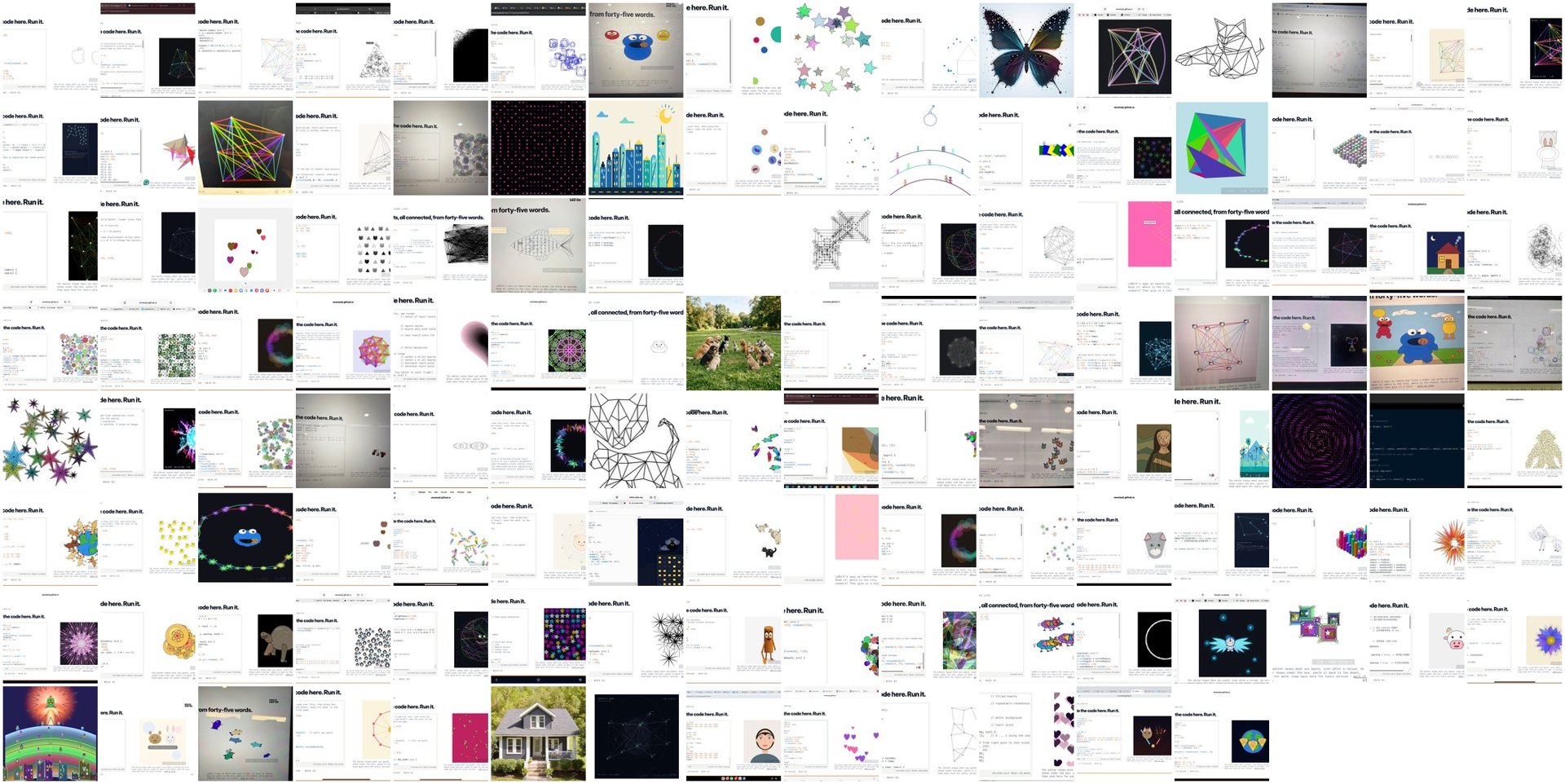
01 · WEEK 2 · THE WALL · 125 PICTURES · ONE RULE EACH · THE CAPTIONS
Every picture the pairs uploaded last week, both rounds: LeWitt's ten points with a twist, then a rule of the pair's own, turned into p5.js by a language model. Nobody defined "a picture"; every one of these is one.
01 · THE SEMESTER
Where we are
1 · What is AI?
Week 1
Two ways to teach a machine
Week 2
Rules that make things: code, chance, generative art
Week 3
Learning from examples: concepts, neurons, Move 37
2 · AI for the creative process
Week 4
Language machines: LLMs, prompts, agents
Week 5
Image machines: diffusion, CLIP, mediation
Week 6
Sound machines: music, voice, spectrograms
Mid-term
Week 7
Mid-term quiz · project pitches · teams · reflection due
3 · AI inside products
Week 8
AI as design material: use vs incorporate
Week 9
Data, bias and privacy
Week 10
Recommendation systems and the feed
4 · The designer's turn
Week 11
Curating outputs and datasets · authorship
Week 12
Language as an interface: chatbots and agents
Showcase
Week 13
Poster fair · final quiz
SD2112 · AI IN DESIGN · WEEK 03
06
02
What is a concept?
ideas · definitions · Plato · Wittgenstein
SD2112 · AI IN DESIGN · WEEK 03
07
02 · THE CLASSICAL THEORY · ARISTOTLE TO THE DICTIONARY
A concept is a definition.
A definition is a list of properties a thing must have to belong: necessary, and together sufficient. Bachelor = man + unmarried.
Categorising is then trivial: check each property, apply the concept. X is a bachelor if X is a man and X is unmarried. A machine can do that.
New ideas by assembly: put definitions together and you have a new one. Kant: analytic, all in the words.
Aristotle, pointing down at the things, is this theory: sort them by the properties they share and keep the ones that are necessary. Plato, pointing up, disagrees.
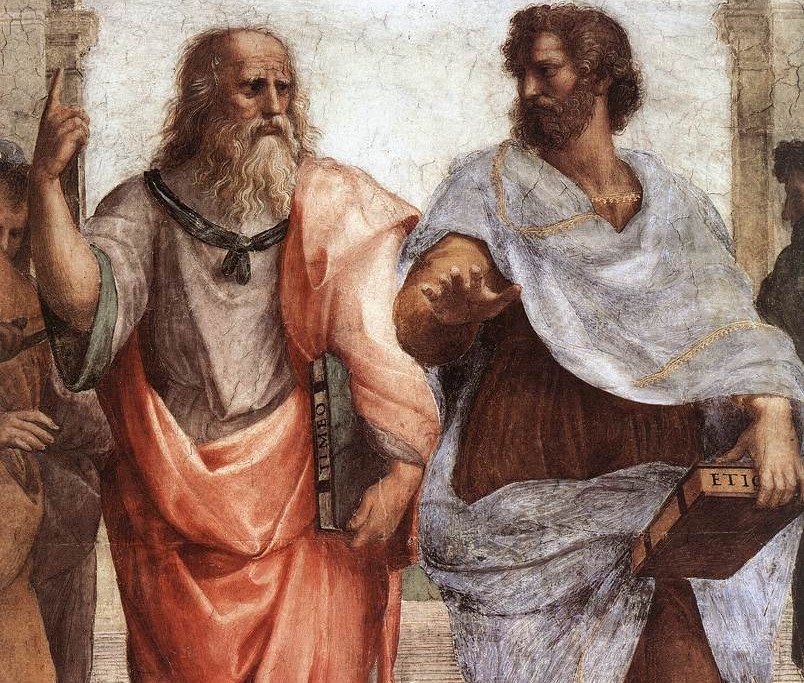
Plato and Aristotle, detail of Raphael's The School of Athens, 1509–1511. Public domain, Wikimedia Commons.
SD2112 · AI IN DESIGN · WEEK 03
08
02 · SOUNDS EASY · TRY THESE
Write the definition.
A PRIME NUMBER
Easy.
Divisible only by one and by itself. Every number is in or out, no argument. Mathematics is where the classical theory lives.
FURNITURE
Try.
Movable, for a room, for living? A lamp? A rug? A built-in wardrobe? Every list you write admits something wrong or leaves out something right.
SUNSET COLOUR
Try.
Orange? Pink? Grey over Kowloon? You know it when you see it, and you cannot say it in a way a stranger could check.
A PIZZA
Try.
Dough, tomato, cheese, baked. Then a white pizza, a calzone, pineapple. Is a pizza defined by its base, its shape, its country, or by pizza places?
AN A+ ESSAY
The rubric tries.
Argument, evidence, structure, style, with bands. It is the best list we can write, and two markers still disagree at the edge.
SD2112 · AI IN DESIGN · WEEK 03
09
"But in what way will you look for it, Socrates, this thing that you don't know at all what it is? Or even if you should meet right up against it, how will you know that this is the thing you didn't know?"
Meno to Socrates. Plato, Meno, 80d, c. 385 BC.
SD2112 · AI IN DESIGN · WEEK 03
10
02 · PLATO · MENO · WHERE IDEAS COME FROM
Ideas are real. Definitions are not their essence.
Socrates calls it a debater's trick: you cannot seek what you know, because you know it, nor what you don't know, because you don't know what to look for.
His answer: learning is remembering. The soul has seen the ideas; the world is a copy; to learn is to recognise. He shows it with a slave boy who "finds" geometry he was never taught.
Whatever you think of the soul, the lesson holds: we have ideas without definitions. The definition is not the essence of a concept.
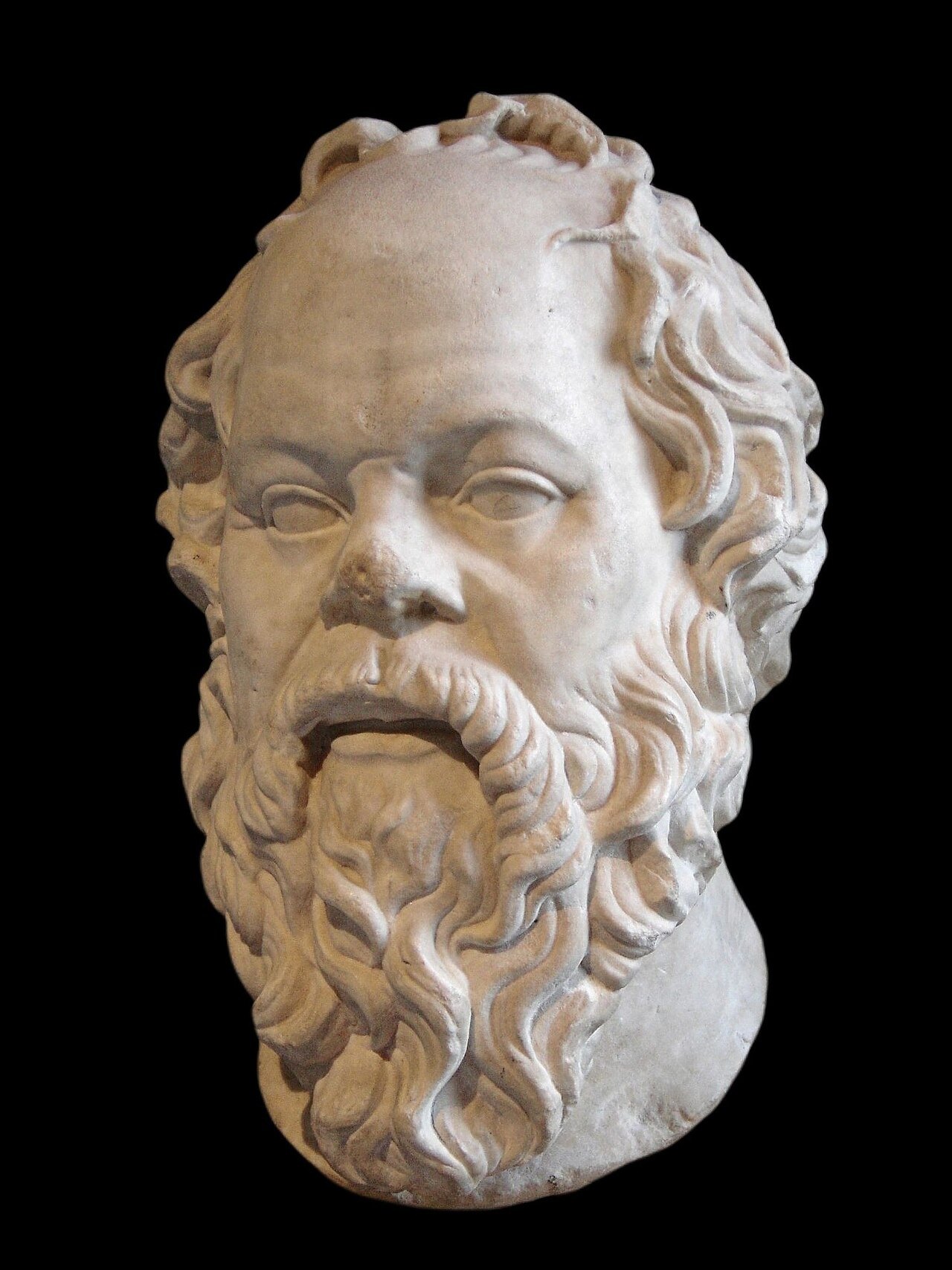
Socrates, Roman marble after a Greek original, 1st century, Louvre. Photo: Eric Gaba, CC BY-SA 2.5, Wikimedia Commons.
SD2112 · AI IN DESIGN · WEEK 03
11
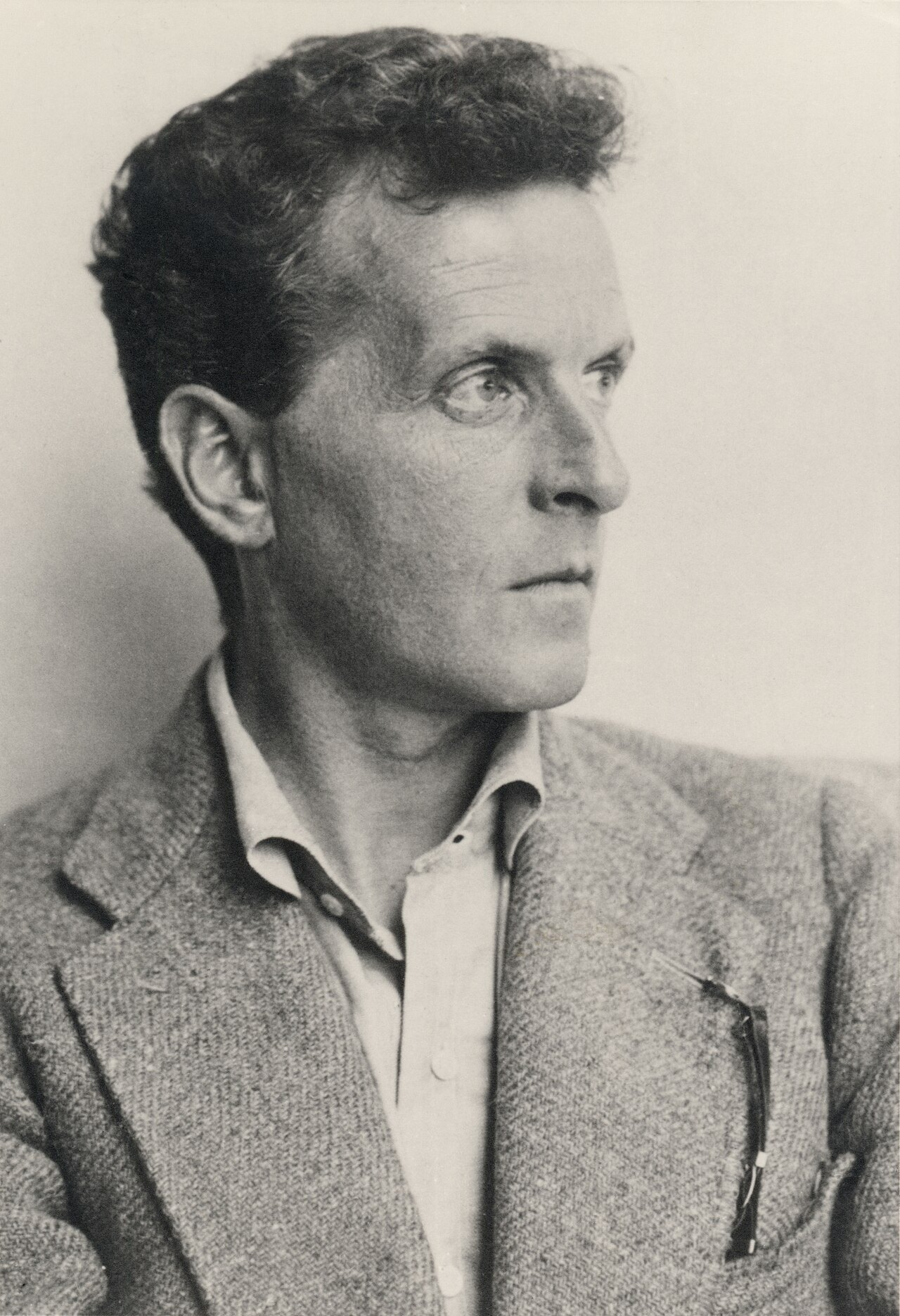
"Don't think, but look!"
Ludwig Wittgenstein, Philosophical Investigations, §66, 1953, on what all games have in common
SD2112 · AI IN DESIGN · WEEK 03
12
02 · WITTGENSTEIN · 1953 · FAMILY RESEMBLANCE
No feature runs through all of them.
Six games, seven features. A definition would need a full column; there is none. Chess and ring-a-ring-a-roses share almost nothing, yet both are games, because a chain of resemblances links them: overlapping and criss-crossing, like the resemblances in a family.
After Philosophical Investigations §66–67. The features are ours; the argument is his.
SD2112 · AI IN DESIGN · WEEK 03
13
02 · THE CLASSICAL THEORY · WHERE IT LEAVES US
Easy to check. Impossible to write.
THE BENEFIT
Categorising is trivial.
Set formal requirements and the check is mechanical: every property, present or absent. That is why a rule-based machine can hold a concept at all: a definition is a rule.
NEW IDEAS
By assembly.
Put two definitions together and you have a third: unmarried + man. Which properties survive when you combine "pet" and "fish"? Assembly is exactly where definitions start to fail.
THE PROBLEM
Most concepts have no definition.
Outside mathematics and law, almost nothing you design has one, and you use those concepts all day without it. So what is a concept, if not a definition?
SD2112 · AI IN DESIGN · WEEK 03
14
03
Prototypes
Rosch · 1975 · a middle and an edge
SD2112 · AI IN DESIGN · WEEK 03
15
03 · QUESTION · WORD CLOUD
Name a fruit. The first one that comes to mind.
One word. Do not think.
SD2112 · AI IN DESIGN · WEEK 03
16
03 · ELEANOR ROSCH · BERKELEY · 1975
I asked people to rate fruits.
Rosch gave about two hundred students lists of items in ten categories, fruit, birds, furniture, vehicles, and asked for each: how good an example of the category is this? From 1, a very good example, to 7, a very poor one.
If a concept were a definition, an orange and an olive would be equally fruit, and the ratings would be noise.
They were not. People agreed, strongly and quickly: some fruits are more fruit than others.
Two papers in 1975, with Carolyn Mervis: typicality is real, shared, and it is made of family resemblance, counted.
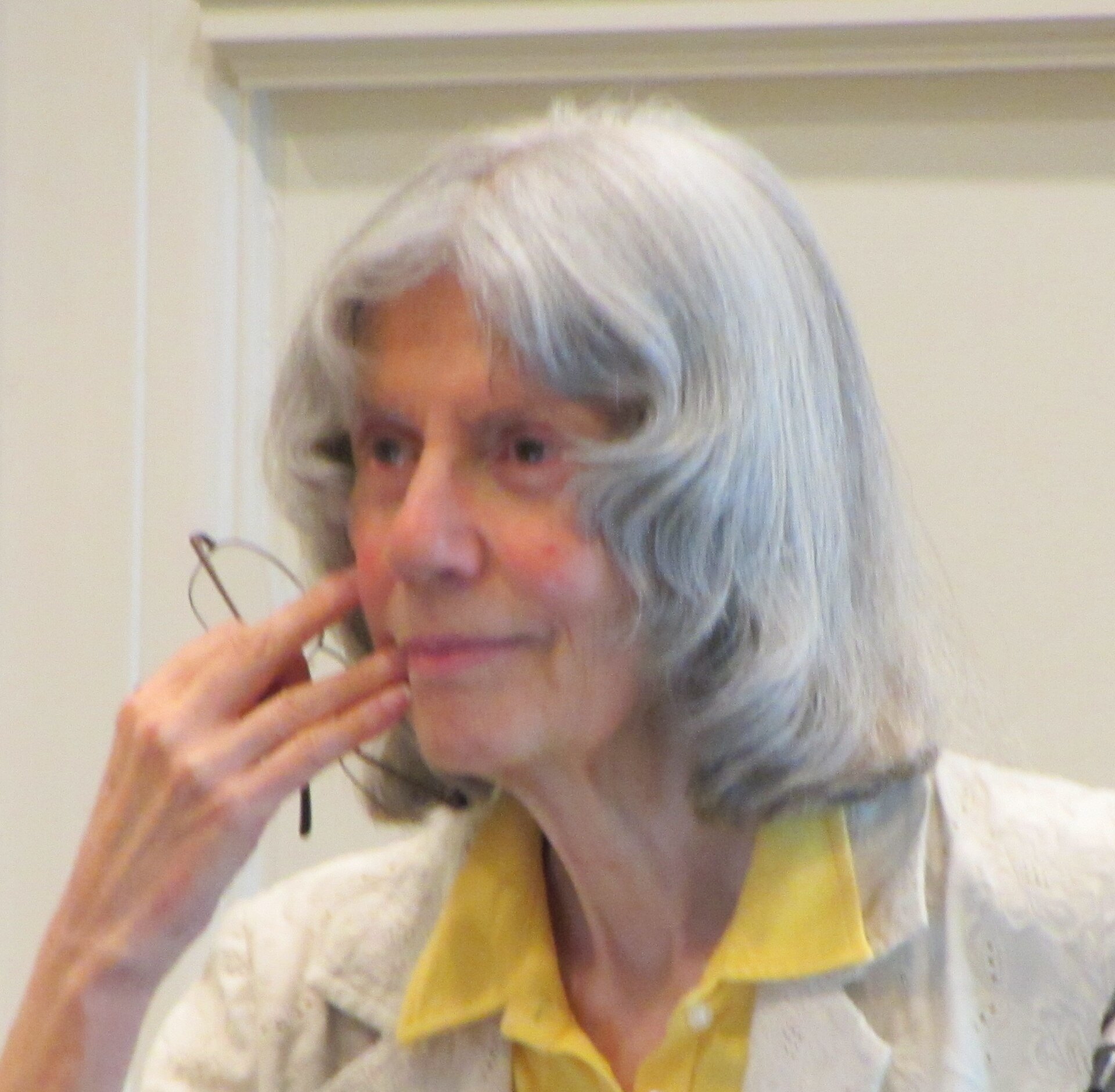
Eleanor Rosch, 2012 (Wikimedia Commons, CC0). Rosch 1975, J. Exp. Psych.: General 104; Rosch & Mervis 1975, Cognitive Psychology 7.
SD2112 · AI IN DESIGN · WEEK 03
17
03 · ROSCH · 1975 · THE FRUIT
Some fruits are more fruit than others.
Thirteen of her fifty-one fruits, in her order. Orange, apple and banana sit at the very top, about 1 on the scale; tomato is above 5; the olive comes last.
Nobody had trouble answering, and the ratings were the same across people: the concept has a shape, and it is shared.
Compare the word cloud. Your first fruit was near the top of this list. A prototype is what a room produces when it does not think.
A concept with a middle and an edge cannot be a definition. Definitions have no middle.
Rank order of Rosch's 1975 goodness-of-example ratings for fruit, 1 = a very good example, 7 = a very poor one; the positions are approximate, the order is hers.
SD2112 · AI IN DESIGN · WEEK 03
18
03 · WHAT TYPICALITY DOES
The middle is faster, first, and easier.
JUDGED
Typical items are called members more often.
Hampton, 1979.
FASTER
Categorising a typical item takes less time.
Rips, Shoben & Smith, 1973.
LEARNED FIRST
Children learn the typical members before the atypical ones.
Rosch & Mervis, 1975.
EASIER TO TEACH
A category is learned faster from typical examples.
Mervis & Pani, 1980.
UNDERSTOOD
In a sentence, a typical member is understood more easily.
Garrod & Sanford, 1977.
SD2112 · AI IN DESIGN · WEEK 03
19
03 · PROTOTYPE THEORY
A concept is its best examples.
THE THEORY
A structured representation of what members tend to have.
Not a list of conditions but a picture of the typical case, and a distance from it. Membership is a degree: a robin is a very good bird, a penguin a poor one, and neither needs a definition.
THE GAIN
Only similarity is needed.
No definition to write: you judge a new thing by how much it resembles what you have seen. That is learning from examples, and it is why a machine can hold "chair" with no rule for it.
THE COST
Outliers, and combinations.
Exceptions are hard: there are fewer examples at the edge, so the edge is unsure. And combining concepts is a puzzle: which properties of "pet" and "fish" does "pet fish" keep?
SD2112 · AI IN DESIGN · WEEK 03
20
03 · QUICK CHECK · MULTIPLE CHOICE
Which sentence is prototype theory?
A
A chair is anything with a seat, a back and at least three legs
B
Every chair shares one feature that makes it a chair
C
Some chairs are better examples of "chair" than others
D
A chair is whatever the dictionary says it is
SD2112 · AI IN DESIGN · WEEK 03
21
04
The birth of AI, twice
1956 · Dartmouth · 1958 · the perceptron
SD2112 · AI IN DESIGN · WEEK 03
22
04 · DARTMOUTH · SUMMER 1956
AI gets its name, and a bet.
31 August 1955: McCarthy, Minsky, Rochester and Shannon propose a summer study "on the basis of the conjecture that every aspect of learning or any other feature of intelligence can in principle be so precisely described that a machine can be made to simulate it."
Summer 1956, Dartmouth: the field gets its name. Turing's intelligence as computation becomes a programme.
Intelligence = analytical reasoning. Symbols, rules, search: the classical theory of concepts, built.
Haugeland named it GOFAI in 1985: good old-fashioned AI.
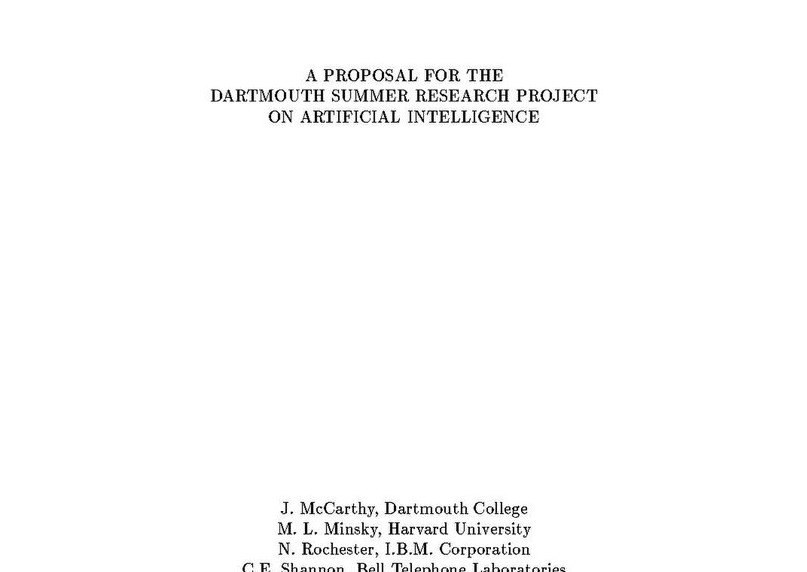
The first page of the proposal, 31 August 1955. Public domain, Wikimedia Commons.
SD2112 · AI IN DESIGN · WEEK 03
23
04 · THE OTHER BIRTH · ROSENBLATT · 1958
A machine modelled on the brain, not on logic.
Frank Rosenblatt, Cornell, 1957–58: the perceptron. Not a program that applies rules but a network of simple units modelled on neurons, whose connections adjust from examples.
Top: a brain, as he drew it: retina, projection areas, association areas, responses. Bottom: the perceptron, the same shape, in wires.
Show it a letter; it guesses; if wrong, the connections that voted wrong are weakened, the ones that voted right strengthened. Again.
No definition of "A" anywhere. The knowledge is in the weights, and the weights come from the examples.
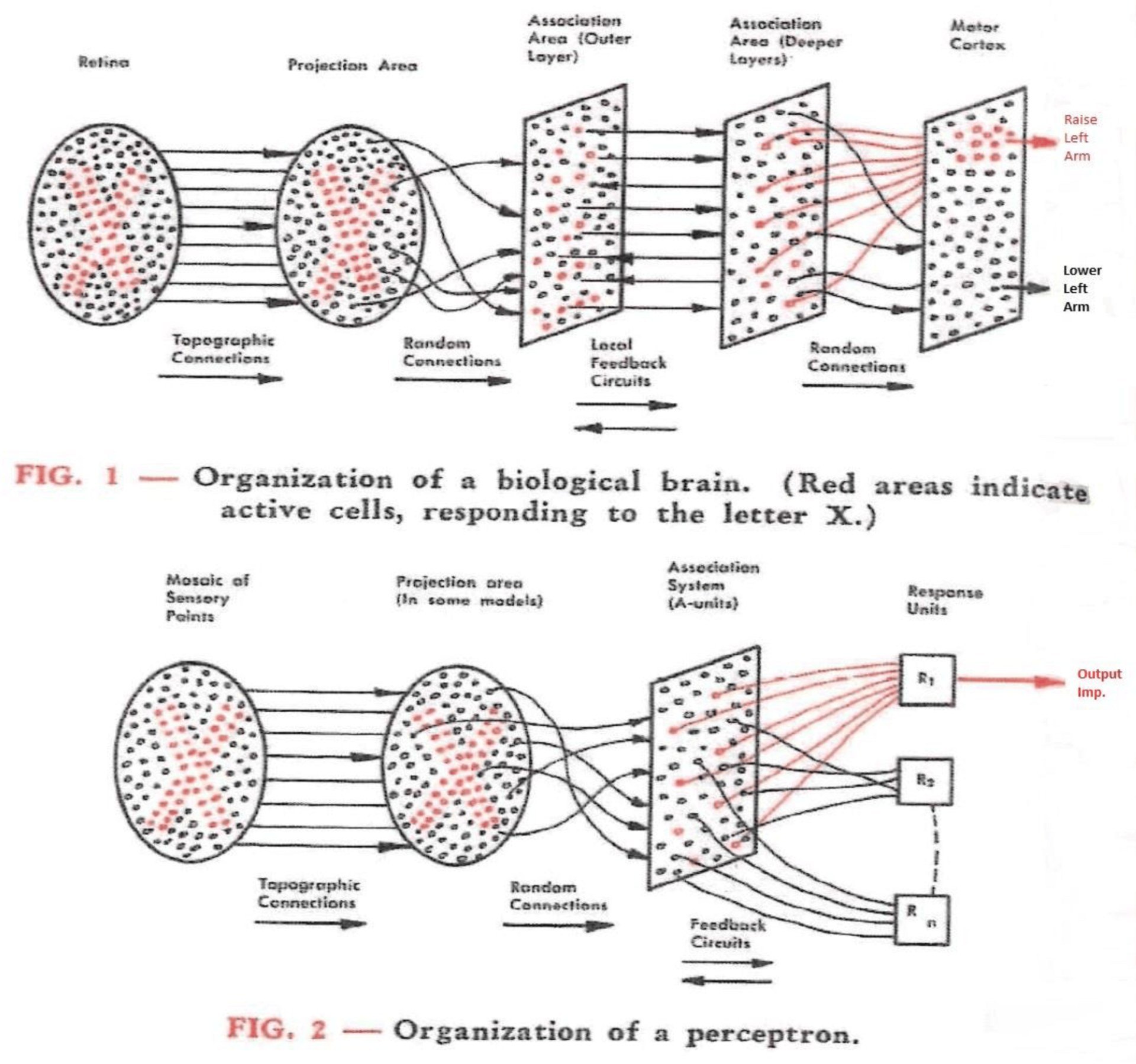
Rosenblatt, "The design of an intelligent automaton", 1958, figures 1 and 2. Public domain, Wikimedia Commons.
SD2112 · AI IN DESIGN · WEEK 03
24
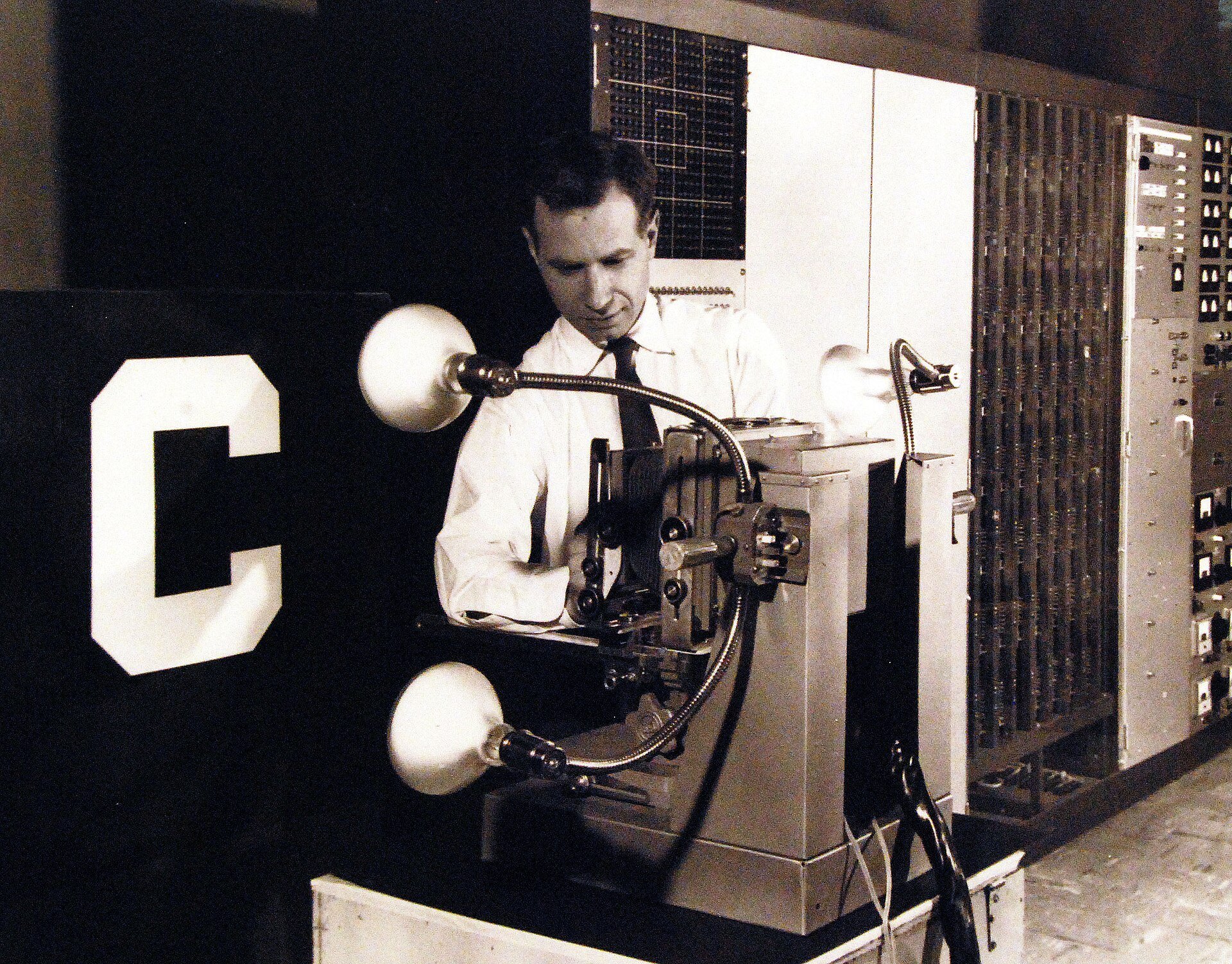
04 · THE MARK I PERCEPTRON · 1960 · PHOTO: US NAVY, PUBLIC DOMAIN
400 photocells look at a letter; motors turn the potentiometers that hold the weights when a guess is wrong. The New York Times, July 1958: the Navy expects it "will be able to walk, talk, see, write, reproduce itself and be conscious of its existence".
04 · ONE NEURON
A neuron is a weighted vote.
Two inputs, two weights, a bias, a threshold. Multiply, add, compare with zero: that is the whole unit. Three numbers hold everything it knows. Rosenblatt, 1958, called it a perceptron; the shape and the size are the week-1 cup.
Rosenblatt, "The perceptron: a probabilistic model for information storage and organization in the brain", Psychological Review 65, 1958. In the html deck the neuron learns live, one example at a time.
SD2112 · AI IN DESIGN · WEEK 03
26
04 · THE PERCEPTRON · WHAT THE CODE DOES
Twenty-four dots, one line, and a nudge.
THE EXAMPLES
Twenty-four points, two classes.
Twelve orange A and twelve teal B, placed with a bell-curve die: most land near the middle of their group, a few stray. These dots are all the machine ever sees.
THE RULE
Three numbers draw one line.
w1, w2 and b are one straight line across the canvas. The rule guesses A on one side of it and B on the other. Where the line starts is arbitrary; it begins wrong.
THE NUDGE
Wrong? Move a little.
Every frame is one pass over the examples. Where the guess is wrong, the three numbers move a little towards that example, so the line turns. When nothing is wrong, it stops: "wrong: 0".
ADD POINTS
Click, and it has to move again.
A click adds an A where you click; shift-click adds a B. Put an A among the Bs and it never settles: one line cannot. C starts again.
SD2112 · AI IN DESIGN · WEEK 03
27
04 · THE PERCEPTRON · 1958 · IN P5.JS
Wrong? Nudge the three numbers. Again.
let pts = [], w1 = 0.3, w2 = -1, b = 0.1;   // three numbers
const lr = 0.05;                            // how big a nudge
const g = (m, s) => randomGaussian(m, s);   // a bell-curve die
function setup() {
  createCanvas(600, 600); randomSeed(3); frameRate(8);
  for (let i = 0; i < 12; i++) {            // twelve A, twelve B
    pts.push([g(-.45, .2), g(-.3, .2), -1]);
    pts.push([g(.45, .2), g(.35, .2), 1]);
  }
}
function guess(x, y) { return w1 * x + w2 * y + b > 0 ? 1 : -1; }
function draw() {                           // one pass per frame
  let wrong = 0;
  for (let [x, y, t] of pts)                // wrong? nudge
    if (guess(x, y) != t) { wrong++;        // a little, towards it
      w1 += lr * t * x; w2 += lr * t * y; b += lr * t; }
  background(255); stroke(0); strokeWeight(2);
  let ya = -(b - w1) / w2, yb = -(b + w1) / w2;   // where the rule
  line(0, 300 - 300 * ya, 600, 300 - 300 * yb);   // says 0
  for (let [x, y, t] of pts) {
    fill(t < 0 ? '#ED6D24' : '#64C2C3');
    circle(300 + 300 * x, 300 - 300 * y, 14);
  }
  fill(0); noStroke(); text('wrong: ' + wrong, 16, 24);
}
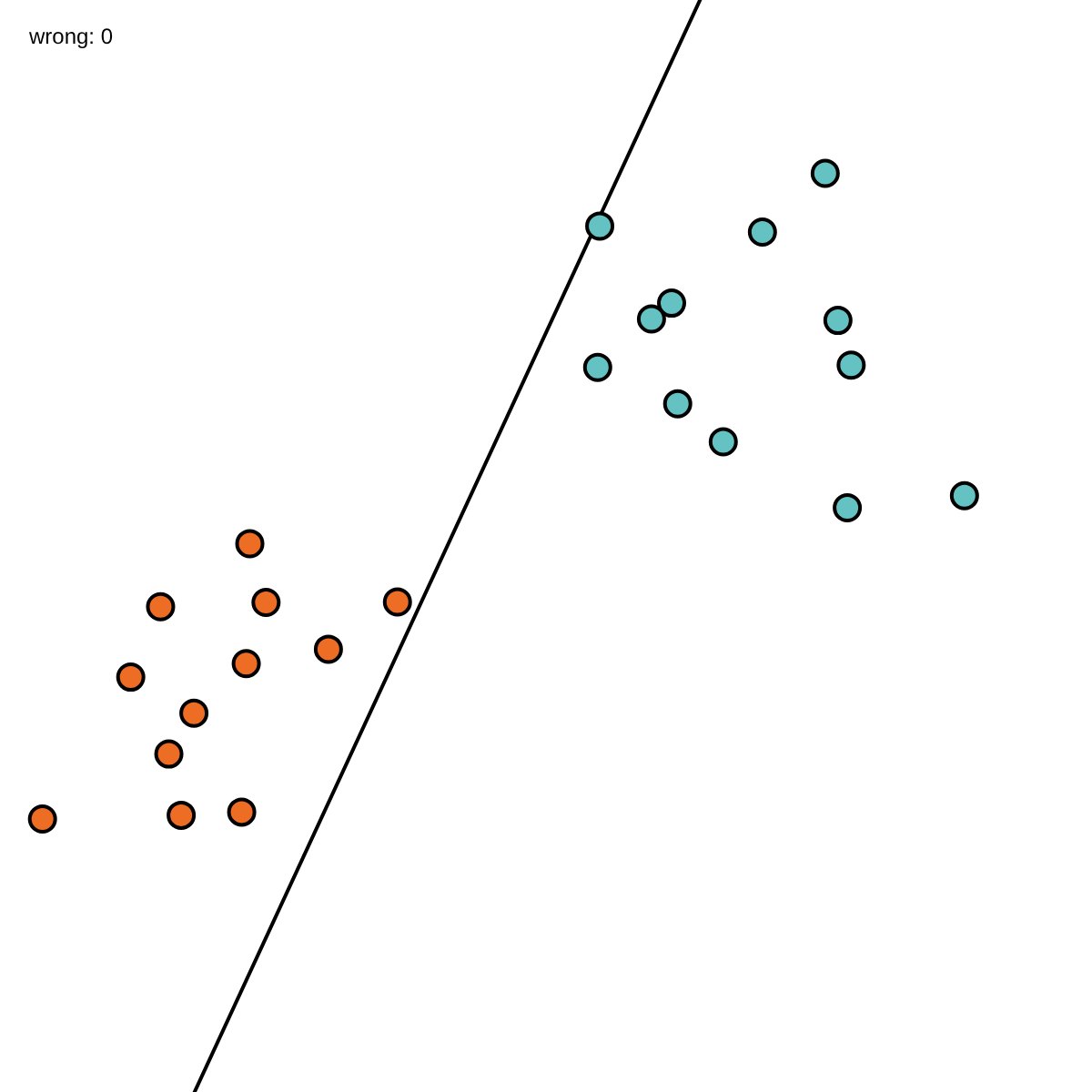
One pass per frame; a wrong guess moves the three numbers a little. "wrong: 0": every example is on its side, the line has settled. Click adds an A, shift-click a B · edit it live.
SD2112 · AI IN DESIGN · WEEK 03
28
04 · 1958 · 1969 · 1986
A machine that learns, and what it took.
1958 · ROSENBLATT
The perceptron.
The paper in Psychological Review, then the Mark I. A machine that learns, and the press promising consciousness within the year. Rosenblatt died in 1971, aged 43, with the idea out of fashion.
1969 · MINSKY & PAPERT
One line cannot.
Perceptrons, the book: a single layer can only draw one straight line, so it cannot even learn XOR. Funding for networks dries up for a decade. The rules school, Minsky's own, wins the seventies.
1986 · BACKPROPAGATION
Rumelhart, Hinton & Williams.
Four pages in Nature: put units in layers, send the error backwards, nudge every weight. Hidden units invent their own features. Connectionism has its learning rule, and the other school of AI is back.
SD2112 · AI IN DESIGN · WEEK 03
29
04 · THE LIMIT, AND THE FIX
One line cannot. Two layers can.
XOR: A on one diagonal, B on the other. No straight line separates them, so one neuron never settles. Add a hidden layer of two neurons and the network can draw two lines and vote on them. The band is a rule nobody wrote.
Minsky & Papert, Perceptrons, 1969 · Rumelhart, Hinton & Williams, "Learning representations by back-propagating errors", Nature 323, 1986.
SD2112 · AI IN DESIGN · WEEK 03
30
05
Neurons that learn
Hinton · connectionism · 1986 · 2012 · 2024
SD2112 · AI IN DESIGN · WEEK 03
31
05 · GEOFFREY HINTON
Fifty years betting on the brain.
A psychologist, like Rosenblatt. 1986: backpropagation, with Rumelhart and Williams, when almost nobody believed in networks.
Connectionism: a concept is a pattern of activity over many units, never a list. Rosch's graded categories as an engineering brief.
2012: with his students Krizhevsky and Sutskever, AlexNet wins ImageNet. 2018: the Turing Award. 2023: leaves Google to speak about the risks.
2024: the Nobel Prize in Physics, with John Hopfield, "for foundational discoveries and inventions that enable machine learning with artificial neural networks".
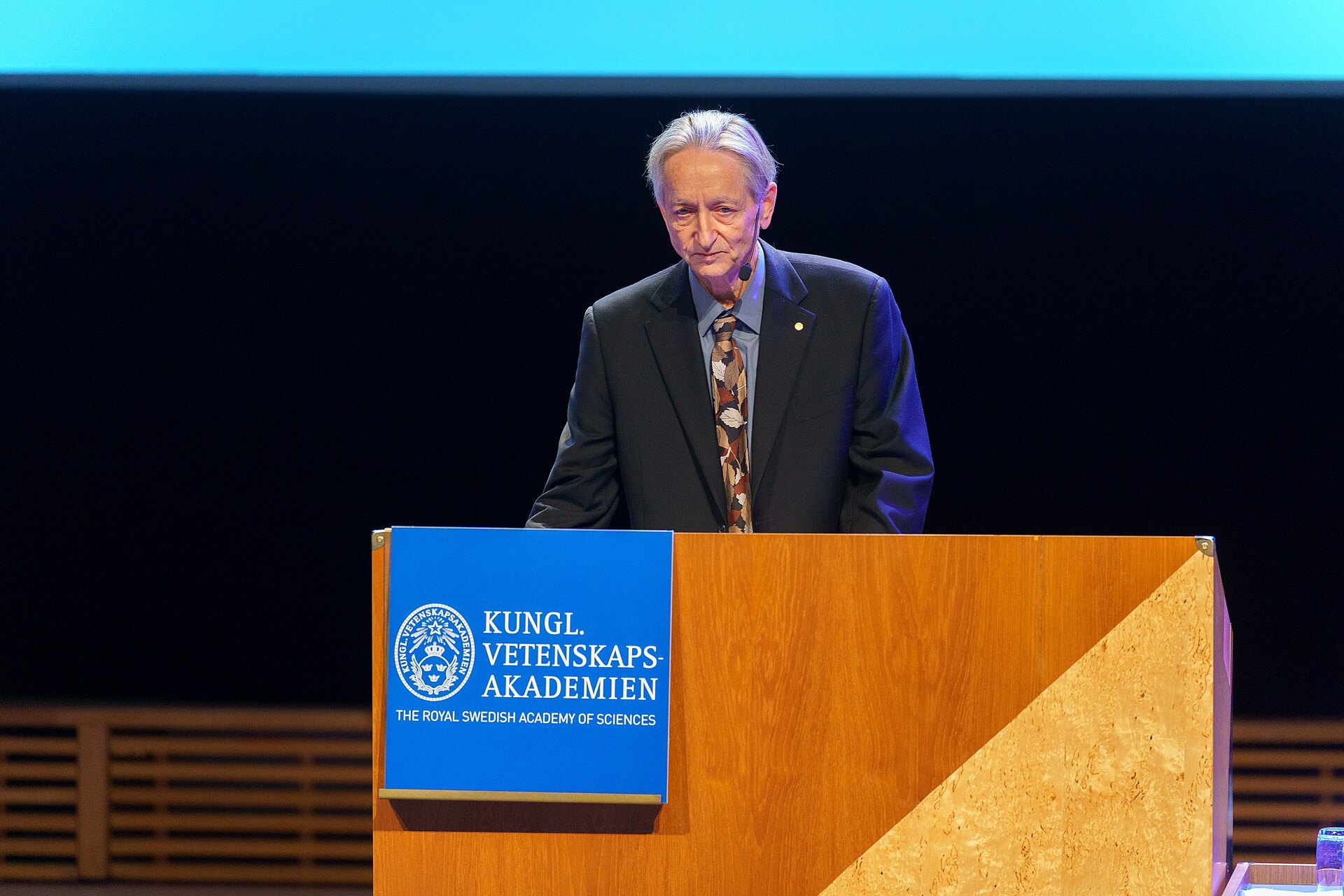
Geoffrey Hinton at the 2024 Nobel Lectures, Stockholm University. Photo: Jay Dixit, CC BY-SA 4.0, Wikimedia Commons.
SD2112 · AI IN DESIGN · WEEK 03
32
05 · BACKPROPAGATION · 1986
Send the error backwards. Nudge every weight.
Forward: every unit sums its inputs, weighted, and passes a number on. At the end, a guess.
Backward: compare the guess with the truth. Share the error out along the same connections, so every weight moves a little, in proportion to its part in the mistake.
Then the next example. A million times.
The perceptron's rule, extended to units that never see the answer directly. Rumelhart, Hinton & Williams, Nature 323, 1986.
SD2112 · AI IN DESIGN · WEEK 03
33
05 · BACKPROPAGATION · 1986 · THE PICTURE, LIVE
The guess goes forward. The error comes back.
Nine pixels in, five and three hidden units, two out: nineteen units, 66 weights. Rumelhart, Hinton & Williams, "Learning representations by back-propagating errors", Nature 323, 1986.
SD2112 · AI IN DESIGN · WEEK 03
34
05 · HUMANS + CONCEPTS · MACHINES + CONCEPTS
Two theories. Two machines.
Rule-based: classical theory + GOFAI, a definition a machine applies. Adaptive: prototype theory + connectionism, examples held in weights nobody can read. Your reflection is about this distinction.
SD2112 · AI IN DESIGN · WEEK 03
35
05 · THE DEAL
Fluent. Fuzzy. Opaque.
FLUENT
It handles the case nobody wrote.
A learned concept covers the middle of its examples and interpolates between them. That is why it can write, draw and see: no list of conditions could.
FUZZY
Every answer is a degree.
Chair 0.93, stool 0.05. There is no line, only a slope, and it moves with the examples. The edge of the concept is exactly where it is least sure, and where you work.
OPAQUE
It cannot say why.
Sixty million numbers found by nudging. No line to point at, no rule to read, no fix but more examples. When it is wrong you cannot ask it; you can only retrain it.
SD2112 · AI IN DESIGN · WEEK 03
36
05 · WHERE WE ARE
Machine A is a rule you wrote. Machine B is a rule nobody wrote.
SD2112 · AI IN DESIGN · WEEK 03
37
AFTER THE BREAK · GPUS · MODERN AI · THEN THE BLEND
Break. Ten minutes.
SD2112 · AI IN DESIGN · WEEK 03
38
06
Parallel
every unit at once · GPUs · 2012 · today
SD2112 · AI IN DESIGN · WEEK 03
39
06 · PARALLEL CALCULATION
Every unit decides on its own.
A Turing machine does one step at a time, and its whole state sits in one place, readable. A network is thousands of small sums that do not wait for each other and share nothing: harder to read, and far faster for some tasks, if you have something that can do thousands of sums at once. For decades, nobody did.
The rule-based machine is serial by nature; the learned one is parallel by nature. The chip you run it on decides whether that is a strength or a wait.
SD2112 · AI IN DESIGN · WEEK 03
40
06 · THE SAME RULE, 240,000 TIMES · IN P5.JS
One core, pixel by pixel. A GPU, all at once.
let cores, i = 0, t0;                 // pixels per frame: a slider
const n = 60, W = 600, H = 400;       // steps per pixel; the canvas
function setup() {
  createCanvas(W, H); pixelDensity(1);
  cores = createSlider(0, 12, 8, 1, 'cores: 2^k');
  cores.input(restart); restart();
}
function restart() {                  // from the top, blank
  background(255); loadPixels(); i = 0; t0 = millis();
}
function draw() {
  let k = 1 << cores.value();         // 2^k pixels in this frame
  for (let j = 0; j < k && i < W * H; j++, i++) {   // pixel i
    let a = (i % W - 420) / 200, b = (floor(i / W) - 200) / 200;
    let x = 0, y = 0, s = 0;            // c; z starts at 0
    while (x * x + y * y < 4 && s < n) {   // z = z² + c, again
      let t = x * x - y * y + a; y = 2 * x * y + b; x = t; s++;
    }
    let v = s == n ? 0 : 255 * sqrt(s / n), q = 4 * i;
    pixels[q] = v * .3; pixels[q + 1] = v * .6; pixels[q + 2] = v;
  }
  updatePixels(); noStroke(); fill(255); rect(0, 380, 600, 20);
  let sec = nf((millis() - t0) / 1000, 1, 1);
  fill(0); text(k + '/frame · ' + i + ' px · ' + sec + ' s', 10, 394);
}
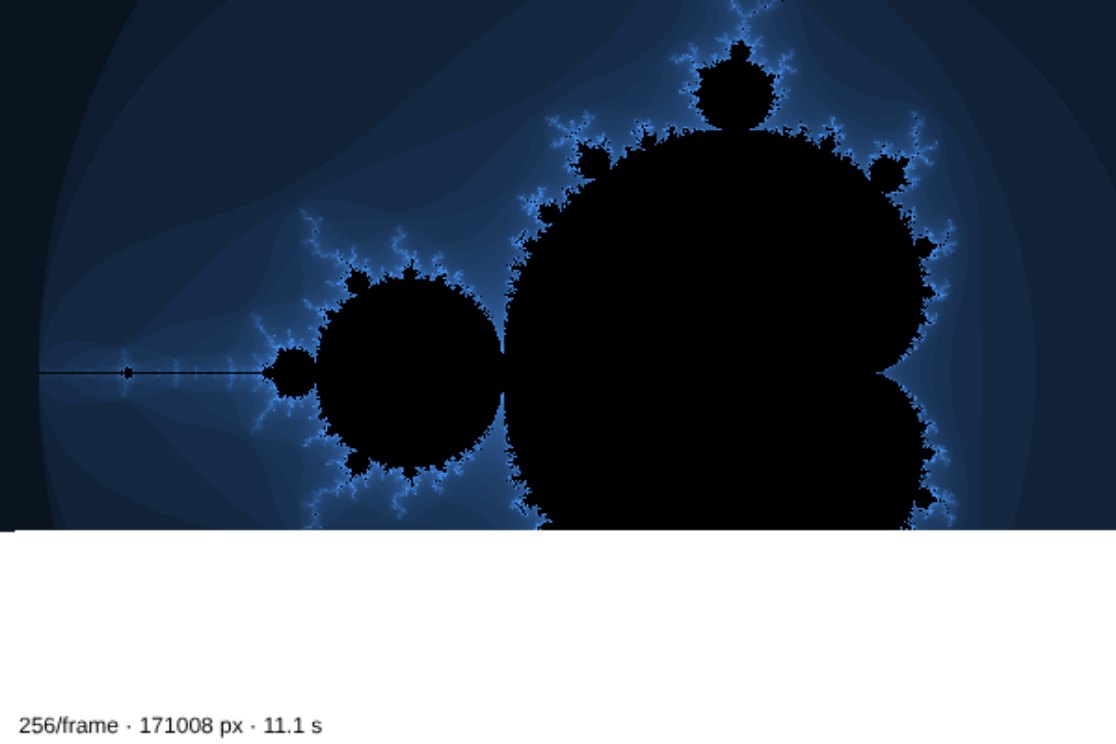
The Mandelbrot rule from week 2, one pixel after another. The slider is how many pixels are done in each frame: 1, or 4,096. Same rule, same picture, a thousand times sooner · edit it live.
SD2112 · AI IN DESIGN · WEEK 03
41
06 · GPUS · NOT ONLY FOR GAMING
The chips made for games.
A graphics processing unit does the same small calculation on millions of pixels at once: textures, shading, vertices, physics. Games needed that, and paid for twenty years of it.
2007: CUDA. NVIDIA opens the chip to any calculation that has the same shape: many small identical jobs, no waiting.
A neural network is exactly that shape: multiply, add, everywhere, at once. What a CPU did in weeks, a graphics card did in days.
The other school of AI finally had its engine.
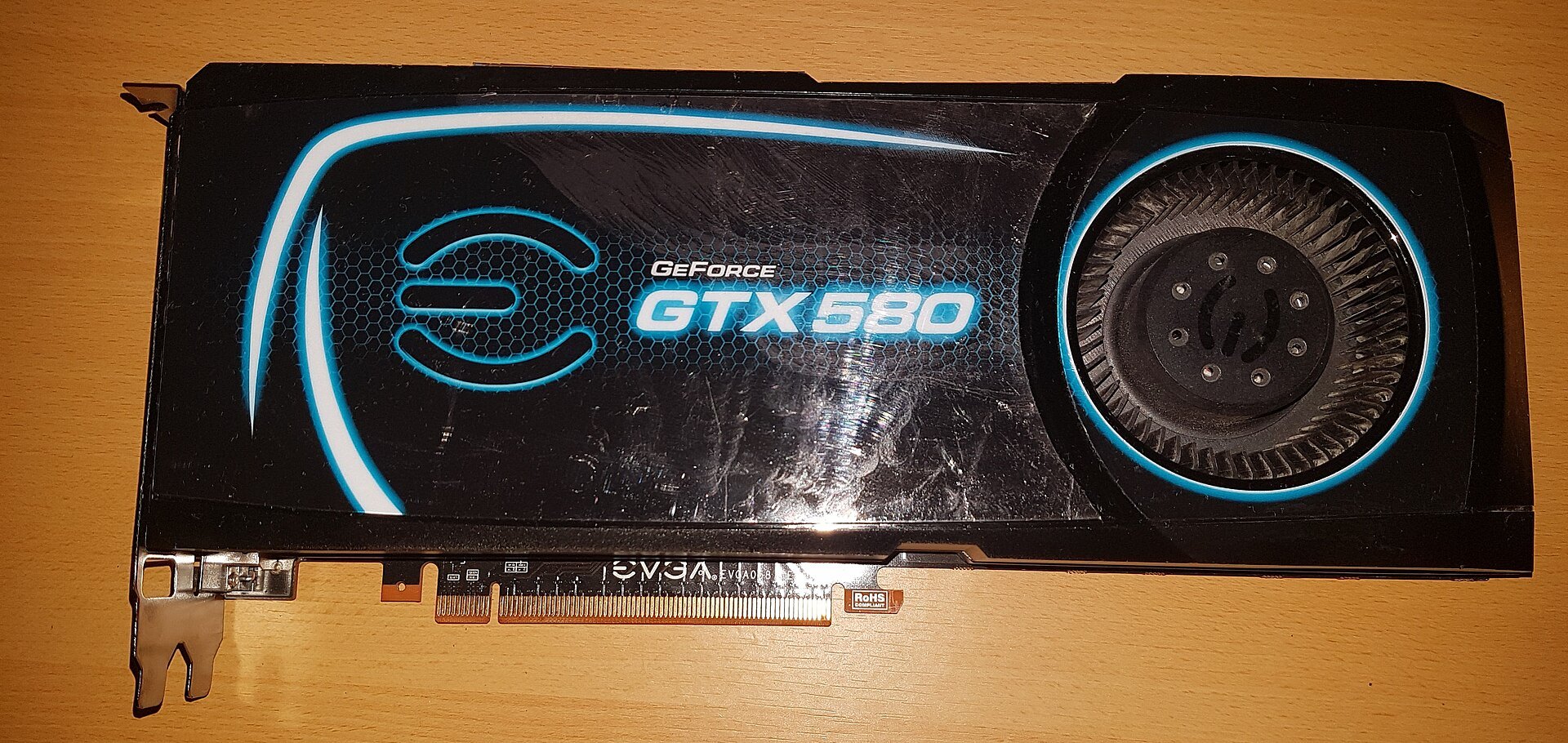
An NVIDIA GeForce GTX 580, late 2010: the card AlexNet was trained on, two of them. Photo: TheStriker, CC BY-SA 4.0, Wikimedia Commons.
SD2112 · AI IN DESIGN · WEEK 03
42
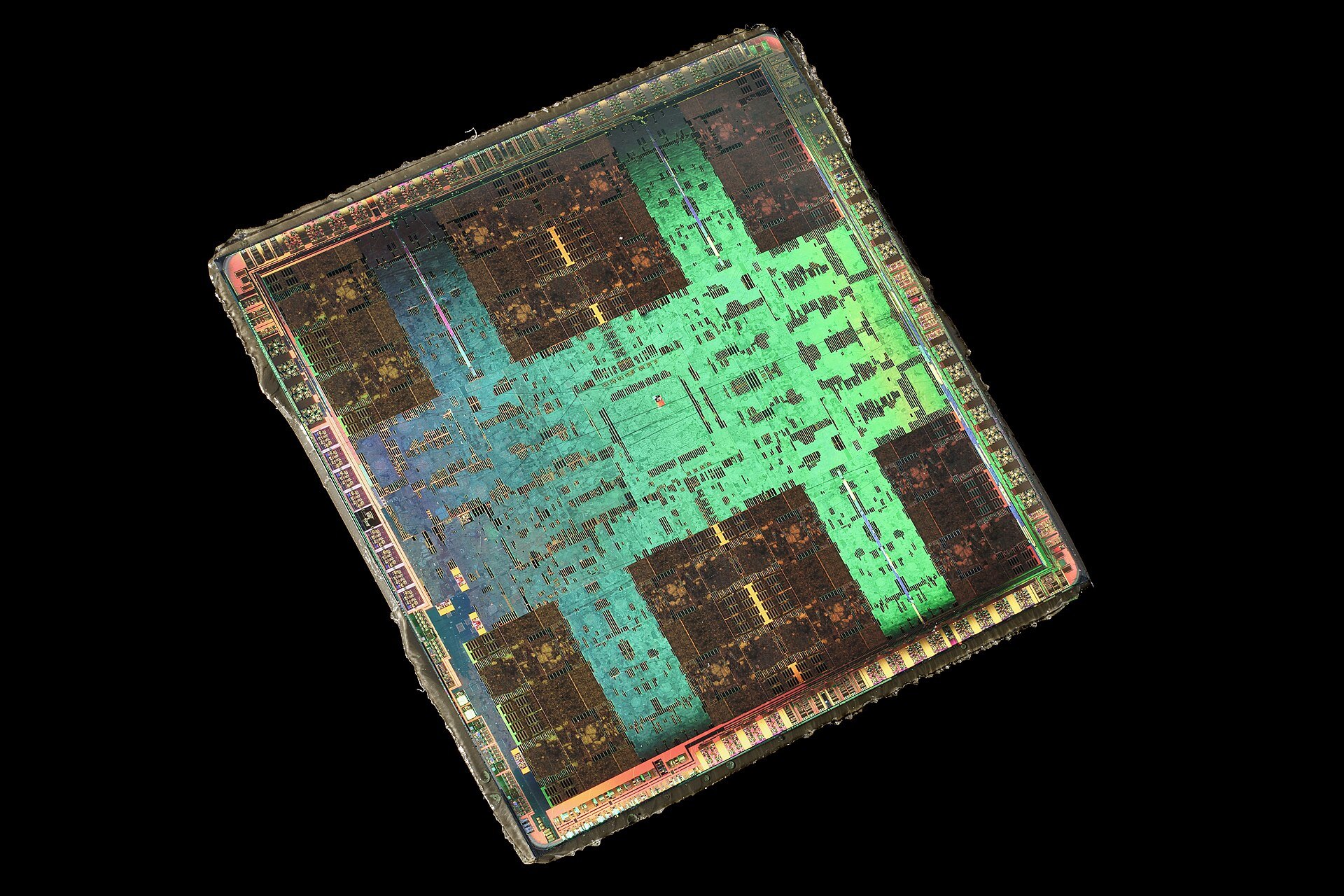
06 · INSIDE THE GTX 580 · THE GF110 DIE · 512 CORES · 3 BILLION TRANSISTORS
The chip under the fan, sanded down and photographed: sixteen blocks of thirty-two small processors, each doing the same job on its own piece of the picture. This, twice, is what learned to see in 2012. Photo: Fritzchens Fritz, CC0, Wikimedia Commons.
06 · 2012 · ALEXNET
Deep: the features are learned too.
30 September 2012: Krizhevsky, Sutskever and Hinton win the ImageNet challenge with an eight-layer network: 15.3% error against 26.2% for the runner-up, trained on 1.2 million labelled photos in about a week on two GTX 580s. The other entries ran on hand-crafted features; AlexNet grew its own from the pixels.
ImageNet: Fei-Fei Li, from 2006; 14 million images labelled by 49,000 Mechanical Turk workers in 167 countries.
SD2112 · AI IN DESIGN · WEEK 03
44
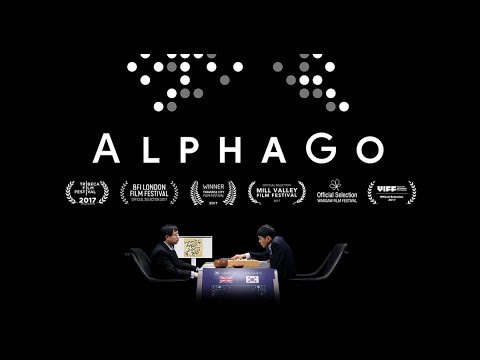
06 · 2016 · ALPHAGO · MOVE 37
A move outside the human middle.
Seoul, 10 March 2016, game two, move 37. The commentators call it a mistake. Humans play it, said DeepMind, one time in ten thousand.
Trained on human games first, then on millions of games against itself. Move 37 came from the second set, and it was right.
Your word cloud at the start of class was the verdict. Creative, alien, or more examples?
SD2112 · AI IN DESIGN · WEEK 03
45
06 · MODERN AI · 2012 – 2026
The same loop, a billion times bigger.
2012
AlexNet
60 million weights, two gaming GPUs, a week. The examples school wins at seeing.
2014
GANs
Two networks, one forging, one judging. Edmond de Belamy, 2018, was one of these.
2017
The transformer
"Attention is all you need": the architecture inside every chatbot since.
2020
GPT-3
175 billion weights, trained on the web. Scale as the strategy.
2022
Diffusion · ChatGPT
Stable Diffusion, then ChatGPT: machine B reaches everyone through a text box.
2024
Two Nobel Prizes
Physics: Hopfield and Hinton, the networks. Chemistry: Hassabis and Jumper, AlphaFold.
2025
Editors that take references
Flux Kontext, Qwen-Image-Edit, FLUX.2: show the model pictures, not only words.
2026
You
Both machines in every tool. The designer decides which, and when, and with which examples.
SD2112 · AI IN DESIGN · WEEK 03
46
06 · HOW MANY NUMBERS · 1958 – 2026
A thousand times more numbers, every ten years.
A learned model is measured by how many numbers it holds: three in our neuron, 60 million in AlexNet, 175 billion in GPT-3, trillions today. The loop never changed; the count did, and the chips that hold it.
SD2112 · AI IN DESIGN · WEEK 03
47
07
Blending concepts
pet fish · houseboat · a picture from two ideas
SD2112 · AI IN DESIGN · WEEK 03
48
07 · COMBINING CONCEPTS
Bachelor was easy. Pet fish is not.
THE CLASSICAL WAY
Add the conditions.
Man + unmarried. A rule combines any two definitions: everything from both, nothing new. It also gives you "fake gun" (a gun?) and "small elephant" (small?). Assembly is where lists show their seams.
THE PROTOTYPE PROBLEM
Typicality does not multiply.
Picture a pet: not a goldfish. Picture a fish: not a goldfish. Picture a pet fish: a goldfish (Osherson & Smith, 1981, who used a guppy). Which properties survive the combination? Nobody has found the rule (Hampton, 1988).
THE BLEND
Two inputs, one new space.
Fauconnier & Turner, 2002: we build a blended space that takes some structure from each input and grows structure of its own. A houseboat, a computer virus, a desk lamp. We do it all day; we cannot say how.
SD2112 · AI IN DESIGN · WEEK 03
49
07 · FAUCONNIER & TURNER · 2002
Two inputs. One new space.
Two input spaces: a house and a boat. A generic space of what they share: a structure, a place, people who use it.
The blend: a houseboat. It took the rooms from the house and the hull from the boat, and it is one thing, not two.
After Fauconnier & Turner, The Way We Think: Conceptual Blending and the Mind's Hidden Complexities, 2002.
SD2112 · AI IN DESIGN · WEEK 03
50
07 · FAUCONNIER & TURNER · WHAT A BLEND DOES
Some stays behind. Some is new.
SELECTIVE PROJECTION
Not every property comes across.
The house's foundations stay behind; so does the boat's cargo. The blend takes what it needs from each input and leaves the rest.
EMERGENT STRUCTURE
The blend has what no input had.
A mooring fee, a bathroom on deck, a view that changes. None of it was in the house or the boat. That is where the new idea lives.
EVERY MASH-UP
A computer virus. A desk lamp. A mermaid.
Every metaphor, every product mash-up, every "what if a chair were a cup" is one of these.
SD2112 · AI IN DESIGN · WEEK 03
51
07 · A MACHINE THAT BLENDS
Show it two pictures. Ask for one.
An image editor that takes references has the examples; a reference image is one more example, placed in front. Give it two and a sentence and one of three things comes back: a collage, both things side by side, which is what a rule would do; a blend, one thing with properties of both, which no definition could do; or the stronger prototype eats the other, which is the middle pulling, as always.
Cup and chair, three outcomes. Making the model blend rather than collage is a prompt-writing skill, and a design skill.
SD2112 · AI IN DESIGN · WEEK 03
52
07 · ON GENAI · IMAGE TO IMAGE
Four moves.
1 · PICK
The model with an image input.
On genai.polyu.edu.hk, choose the image editor that takes reference images: Flux, or Qwen Image Edit. Up to three images in. Same login as week 1.
2 · SHOW
Attach the references.
One to three pictures: your own from round 1, your partner's, one more if it helps. Each one is an example the model stands near. Their order matters: image 1 pulls hardest.
3 · TELL
One sentence, and what from where.
"Blend image 1 and image 2 into one thing: the shape of the first, the material of the second." Say "one thing, not two". A reference cannot forbid; the sentence can ask.
4 · ITERATE
One change per run.
Swap a reference, or change one phrase, never both: then you know which machine answered. Keep every prompt with its picture; the caption is the prompt and the references.
SD2112 · AI IN DESIGN · WEEK 03
53
07 · A PROMPT FOR A BLEND
Say what comes from where.
Fill the brackets. Attach the images in the order the prompt names them. Run once, look, change one line.
Name the thing you want as one noun if you can: "a lamp", "a room", "a creature". A blend needs a home.
Say what each image gives. Left open, the model averages, and the stronger prototype wins.
Ask for the line back: what it took from each. If it cannot say, look harder at the picture.
Blend the two concepts into ONE thing.
IMAGE 1 is [concept A]:
keep its [shape / colour / mood].
IMAGE 2 is [concept B]:
keep its [material / setting / use].
The result is a single object or scene,
not two things side by side.
Photographic, plain background.
Nothing I did not ask for.
Then, in one line: what did you take
from each image?
SD2112 · AI IN DESIGN · WEEK 03
54
08
The blend.
30 minutes · alone, then in pairs · genai.polyu.edu.hk
SD2112 · AI IN DESIGN · WEEK 03
55
ACTIVITY · 1 — ALONE
8 min
Pick a concept. Make it visible.
Any concept: as specific as your first bicycle, as broad as justice; abstract or concrete. Then: how would a picture say it? Write the prompt, text only, and generate on genai.polyu.edu.hk.
Look. Does the picture say the concept to a stranger? Change one thing, run again. Two runs at most.
Upload it. Caption: the concept, in 50 characters or fewer. That caption is what your partner will work from.
ROUND 1 · ALONE · 8 MIN
1. Pick a concept. Anything:
as small as "my first bicycle",
as big as "justice"; concrete or
abstract; "Tuesday", "hospitality",
"a minibus at 2 am", "entropy".
2. How would a picture say it?
Write the prompt. Text only.
3. Generate. Look. Change one thing.
Two runs at most.
4. Upload. Caption: the concept,
50 characters or fewer.
SD2112 · AI IN DESIGN · WEEK 03
56
08 · CAPTURE 1 · IMAGE UPLOAD · EVERYONE
Everyone: your concept, as a picture.
The image from round 1. Caption: the concept, 50 characters or fewer.
SD2112 · AI IN DESIGN · WEEK 03
57
ACTIVITY · 2 — IN PAIRS
12 min
Blend two concepts into one picture.
Show each other your picture and your concept. Talk: how could the two become one thing, not two things side by side? What does each contribute?
Write the prompt together, from the template. Images in: your two pictures, plus one more if it helps; three at most. The image editor on GenAI. Two runs.
One upload per pair. Caption: concept A + concept B, and one line on what came from each.
ROUND 2 · IN PAIRS · 12 MIN
1. Show each other the picture and
the concept. Two minutes.
2. Talk: how could the two become
ONE thing? What from each?
3. Write the prompt together
(template, previous slide).
Images in: your two pictures,
plus one more if it helps. Max 3.
4. Image edit model. Two runs.
5. One upload. Caption:
A + B, and what came from each.
SD2112 · AI IN DESIGN · WEEK 03
58
08 · CAPTURE 2 · IMAGE UPLOAD · ONE PER PAIR
One per pair: the blend.
The image from round 2. Caption: A + B, and what came from each.
SD2112 · AI IN DESIGN · WEEK 03
59
08 · WHAT JUST HAPPENED
You blended concepts with a machine that has no definitions.
Alone: your concept became its prototype. The picture the model found first was the middle of its examples, the typical bicycle, the typical justice. Rosch, on the wall.
In pairs: a blend, or a collage, or one concept ate the other. Where you got a collage, the machine combined like a rule: both, side by side. Where you got a blend, it did what no definition can do, and you cannot say how, and neither can it.
Where a concept got lost, it was the one with the weaker prototype. The middle pulls, in a mind and in a machine. You chose which pictures went in, and in what order.
The machine made every image. You chose the concepts. That was the design.
SD2112 · AI IN DESIGN · WEEK 03
60
08 · CHALLENGE 2 · DUE BEFORE WEEK 4
A picture from text and references.
THE CONCEPTS
Two or three, in a line each.
Your own, not today's. Say each in a line: what it is, and what a picture of it must have.
THE REFERENCES
One to three images, yours.
Your photographs, your drawings, your round-1 picture: not other people's work. Say what each one is for.
THE RESULT
One image, on Canvas.
The image, the prompt word for word, the references, and one sentence: what came from where, and what got lost. Name the model.
THE VOTE
Bring it next week.
The room votes in week 4; the winners get shown and a participation star. Evidence for your reflection: your second experiment of five.
SD2112 · AI IN DESIGN · WEEK 03
61
08 · HOMEWORK · WATCH BEFORE WEEK 4
Next week: language machines.
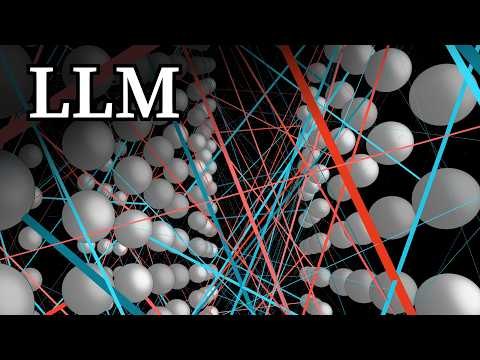
3Blue1Brown, "Large Language Models explained briefly": eight minutes on tokens, embeddings and transformers, the machine B that writes.
Watch it before class; the quiz in week 7 draws on it.
Bring the specs from week 2: next week they become briefs.
Also: a laptop, and your GenAI login.
SD2112 · AI IN DESIGN · WEEK 03
62
See you next week. Language machines.
venetanji.github.io/sd2112-teaching · www.youtube.com/playlist?list=PLU58DFEI5YDQ
a·t4x
POLYU SCHOOL OF DESIGN · SD2112 · WEEK 03 · LECTURE + WORKSHOP
Week 3 — concepts, neurons, GPUs, and a picture that blends two ideas.
SD2112 · WEEK 03
01 Last week, in your words
02 What is a concept?
03 Prototypes: Rosch, 1975
04 The birth of AI, twice
05 Neurons that learn: Hinton
06 Parallel: GPUs and modern AI
07 Blending concepts
08 Activity: the blend
01
THE FILM · THE WALL · THE MAP
01 · QUESTION · WORD CLOUD
You watched the film. The first word that comes to mind.
ClassPoint · word cloud — answer on the projector
01 · WEEK 2 · THE WALL · 125 PICTURES · ONE RULE EACH · THE CAPTIONS
Every picture the pairs uploaded last week, both rounds: LeWitt's ten points with a twist, then a rule of the pair's own, turned into p5.js by a language model. Nobody defined "a picture"; every one of these is one.
01 · THE SEMESTER
1 · What is AI?
WEEK 1
Two ways to teach a machine
WEEK 2
Rules that make things: code, chance, generative art
WEEK 3
Learning from examples: concepts, neurons, Move 37
2 · AI for the creative process
WEEK 4
Language machines: LLMs, prompts, agents
WEEK 5
Image machines: diffusion, CLIP, mediation
WEEK 6
Sound machines: music, voice, spectrograms
Mid-term
WEEK 7
Mid-term quiz · project pitches · teams · reflection due
3 · AI inside products
WEEK 8
AI as design material: use vs incorporate
WEEK 9
Data, bias and privacy
WEEK 10
Recommendation systems and the feed
4 · The designer's turn
WEEK 11
Curating outputs and datasets · authorship
WEEK 12
Language as an interface: chatbots and agents
Showcase
WEEK 13
Poster fair · final quiz
02
IDEAS · DEFINITIONS · PLATO · WITTGENSTEIN
02 · THE CLASSICAL THEORY · ARISTOTLE TO THE DICTIONARY
A definition is a list of properties a thing must have to belong: necessary, and together sufficient. Bachelor = man + unmarried.
Aristotle, pointing down at the things, is this theory: sort them by the properties they share and keep the ones that are necessary. Plato, pointing up, disagrees.
Plato and Aristotle, detail of Raphael's The School of Athens, 1509–1511. Public domain, Wikimedia Commons.
02 · SOUNDS EASY · TRY THESE
A PRIME NUMBER
Easy.
Divisible only by one and by itself. Every number is in or out, no argument. Mathematics is where the classical theory lives.
FURNITURE
Try.
Movable, for a room, for living? A lamp? A rug? A built-in wardrobe? Every list you write admits something wrong or leaves out something right.
SUNSET COLOUR
Try.
Orange? Pink? Grey over Kowloon? You know it when you see it, and you cannot say it in a way a stranger could check.
A PIZZA
Try.
Dough, tomato, cheese, baked. Then a white pizza, a calzone, pineapple. Is a pizza defined by its base, its shape, its country, or by pizza places?
AN A+ ESSAY
The rubric tries.
Argument, evidence, structure, style, with bands. It is the best list we can write, and two markers still disagree at the edge.
Meno to Socrates. Plato, Meno, 80d, c. 385 BC.
02 · PLATO · MENO · WHERE IDEAS COME FROM
Socrates calls it a debater's trick: you cannot seek what you know, because you know it, nor what you don't know, because you don't know what to look for.
Whatever you think of the soul, the lesson holds: we have ideas without definitions. The definition is not the essence of a concept.
Socrates, Roman marble after a Greek original, 1st century, Louvre. Photo: Eric Gaba, CC BY-SA 2.5, Wikimedia Commons.
Ludwig Wittgenstein, Philosophical Investigations, §66, 1953, on what all games have in common
02 · WITTGENSTEIN · 1953 · FAMILY RESEMBLANCE
Six games, seven features. A definition would need a full column; there is none. Chess and ring-a-ring-a-roses share almost nothing, yet both are games, because a chain of resemblances links them: overlapping and criss-crossing, like the resemblances in a family.
After Philosophical Investigations §66–67. The features are ours; the argument is his.
02 · THE CLASSICAL THEORY · WHERE IT LEAVES US
THE BENEFIT
Set formal requirements and the check is mechanical: every property, present or absent. That is why a rule-based machine can hold a concept at all: a definition is a rule.
NEW IDEAS
Put two definitions together and you have a third: unmarried + man. Which properties survive when you combine "pet" and "fish"? Assembly is exactly where definitions start to fail.
THE PROBLEM
Outside mathematics and law, almost nothing you design has one, and you use those concepts all day without it. So what is a concept, if not a definition?
03
ROSCH · 1975 · A MIDDLE AND AN EDGE
03 · QUESTION · WORD CLOUD
One word. Do not think.
ClassPoint · word cloud — answer on the projector
03 · ELEANOR ROSCH · BERKELEY · 1975
Rosch gave about two hundred students lists of items in ten categories, fruit, birds, furniture, vehicles, and asked for each: how good an example of the category is this? From 1, a very good example, to 7, a very poor one.
Two papers in 1975, with Carolyn Mervis: typicality is real, shared, and it is made of family resemblance, counted.
Eleanor Rosch, 2012 (Wikimedia Commons, CC0). Rosch 1975, J. Exp. Psych.: General 104; Rosch & Mervis 1975, Cognitive Psychology 7.
03 · ROSCH · 1975 · THE FRUIT
Thirteen of her fifty-one fruits, in her order. Orange, apple and banana sit at the very top, about 1 on the scale; tomato is above 5; the olive comes last.
A concept with a middle and an edge cannot be a definition. Definitions have no middle.
Rank order of Rosch's 1975 goodness-of-example ratings for fruit, 1 = a very good example, 7 = a very poor one; the positions are approximate, the order is hers.
03 · WHAT TYPICALITY DOES
JUDGED
Typical items are called members more often.
Hampton, 1979.
FASTER
Categorising a typical item takes less time.
Rips, Shoben & Smith, 1973.
LEARNED FIRST
Children learn the typical members before the atypical ones.
Rosch & Mervis, 1975.
EASIER TO TEACH
A category is learned faster from typical examples.
Mervis & Pani, 1980.
UNDERSTOOD
In a sentence, a typical member is understood more easily.
Garrod & Sanford, 1977.
03 · PROTOTYPE THEORY
THE THEORY
Not a list of conditions but a picture of the typical case, and a distance from it. Membership is a degree: a robin is a very good bird, a penguin a poor one, and neither needs a definition.
THE GAIN
No definition to write: you judge a new thing by how much it resembles what you have seen. That is learning from examples, and it is why a machine can hold "chair" with no rule for it.
THE COST
Exceptions are hard: there are fewer examples at the edge, so the edge is unsure. And combining concepts is a puzzle: which properties of "pet" and "fish" does "pet fish" keep?
03 · QUICK CHECK · MULTIPLE CHOICE
A A chair is anything with a seat, a back and at least three legs
B Every chair shares one feature that makes it a chair
C Some chairs are better examples of "chair" than others
D A chair is whatever the dictionary says it is
ClassPoint · multiple choice — answer on the projector
04
1956 · DARTMOUTH · 1958 · THE PERCEPTRON
04 · DARTMOUTH · SUMMER 1956
31 August 1955: McCarthy, Minsky, Rochester and Shannon propose a summer study "on the basis of the conjecture that every aspect of learning or any other feature of intelligence can in principle be so precisely described that a machine can be made to simulate it."
Haugeland named it GOFAI in 1985: good old-fashioned AI.
The first page of the proposal, 31 August 1955. Public domain, Wikimedia Commons.
04 · THE OTHER BIRTH · ROSENBLATT · 1958
Frank Rosenblatt, Cornell, 1957–58: the perceptron. Not a program that applies rules but a network of simple units modelled on neurons, whose connections adjust from examples.
No definition of "A" anywhere. The knowledge is in the weights, and the weights come from the examples.
Rosenblatt, "The design of an intelligent automaton", 1958, figures 1 and 2. Public domain, Wikimedia Commons.
04 · THE MARK I PERCEPTRON · 1960 · PHOTO: US NAVY, PUBLIC DOMAIN
400 photocells look at a letter; motors turn the potentiometers that hold the weights when a guess is wrong. The New York Times, July 1958: the Navy expects it "will be able to walk, talk, see, write, reproduce itself and be conscious of its existence".
04 · ONE NEURON
Two inputs, two weights, a bias, a threshold. Multiply, add, compare with zero: that is the whole unit. Three numbers hold everything it knows. Rosenblatt, 1958, called it a perceptron; the shape and the size are the week-1 cup.
Rosenblatt, "The perceptron: a probabilistic model for information storage and organization in the brain", Psychological Review 65, 1958. In the html deck the neuron learns live, one example at a time.
Open the live sketch › — click = pause · C = start again
04 · THE PERCEPTRON · WHAT THE CODE DOES
THE EXAMPLES
Twenty-four points, two classes.
Twelve orange A and twelve teal B, placed with a bell-curve die: most land near the middle of their group, a few stray. These dots are all the machine ever sees.
THE RULE
Three numbers draw one line.
w1, w2 and b are one straight line across the canvas. The rule guesses A on one side of it and B on the other. Where the line starts is arbitrary; it begins wrong.
THE NUDGE
Wrong? Move a little.
Every frame is one pass over the examples. Where the guess is wrong, the three numbers move a little towards that example, so the line turns. When nothing is wrong, it stops: "wrong: 0".
ADD POINTS
Click, and it has to move again.
A click adds an A where you click; shift-click adds a B. Put an A among the Bs and it never settles: one line cannot. C starts again.
04 · THE PERCEPTRON · 1958 · IN P5.JS
let pts = [], w1 = 0.3, w2 = -1, b = 0.1;   // three numbers
const lr = 0.05;                            // how big a nudge
const g = (m, s) => randomGaussian(m, s);   // a bell-curve die
function setup() {
  createCanvas(600, 600); randomSeed(3); frameRate(8);
  for (let i = 0; i < 12; i++) {            // twelve A, twelve B
    pts.push([g(-.45, .2), g(-.3, .2), -1]);
    pts.push([g(.45, .2), g(.35, .2), 1]);
  }
}
function guess(x, y) { return w1 * x + w2 * y + b > 0 ? 1 : -1; }
function draw() {                           // one pass per frame
  let wrong = 0;
  for (let [x, y, t] of pts)                // wrong? nudge
    if (guess(x, y) != t) { wrong++;        // a little, towards it
      w1 += lr * t * x; w2 += lr * t * y; b += lr * t; }
  background(255); stroke(0); strokeWeight(2);
  let ya = -(b - w1) / w2, yb = -(b + w1) / w2;   // where the rule
  line(0, 300 - 300 * ya, 600, 300 - 300 * yb);   // says 0
  for (let [x, y, t] of pts) {
    fill(t < 0 ? '#ED6D24' : '#64C2C3');
    circle(300 + 300 * x, 300 - 300 * y, 14);
  }
  fill(0); noStroke(); text('wrong: ' + wrong, 16, 24);
}
One pass per frame; a wrong guess moves the three numbers a little. "wrong: 0": every example is on its side, the line has settled. Click adds an A, shift-click a B · edit it live.
Open the live sketch › — click = add an A · shift-click = a B · C = again
04 · 1958 · 1969 · 1986
1958 · ROSENBLATT
The paper in Psychological Review, then the Mark I. A machine that learns, and the press promising consciousness within the year. Rosenblatt died in 1971, aged 43, with the idea out of fashion.
1969 · MINSKY & PAPERT
Perceptrons, the book: a single layer can only draw one straight line, so it cannot even learn XOR. Funding for networks dries up for a decade. The rules school, Minsky's own, wins the seventies.
1986 · BACKPROPAGATION
Four pages in Nature: put units in layers, send the error backwards, nudge every weight. Hidden units invent their own features. Connectionism has its learning rule, and the other school of AI is back.
04 · THE LIMIT, AND THE FIX
XOR: A on one diagonal, B on the other. No straight line separates them, so one neuron never settles. Add a hidden layer of two neurons and the network can draw two lines and vote on them. The band is a rule nobody wrote.
Minsky & Papert, Perceptrons, 1969 · Rumelhart, Hinton & Williams, "Learning representations by back-propagating errors", Nature 323, 1986.
05
HINTON · CONNECTIONISM · 1986 · 2012 · 2024
05 · GEOFFREY HINTON
A psychologist, like Rosenblatt. 1986: backpropagation, with Rumelhart and Williams, when almost nobody believed in networks.
2024: the Nobel Prize in Physics, with John Hopfield, "for foundational discoveries and inventions that enable machine learning with artificial neural networks".
Geoffrey Hinton at the 2024 Nobel Lectures, Stockholm University. Photo: Jay Dixit, CC BY-SA 4.0, Wikimedia Commons.
05 · BACKPROPAGATION · 1986
Forward: every unit sums its inputs, weighted, and passes a number on. At the end, a guess.
The perceptron's rule, extended to units that never see the answer directly. Rumelhart, Hinton & Williams, Nature 323, 1986.
05 · BACKPROPAGATION · 1986 · THE PICTURE, LIVE
Nine pixels in, five and three hidden units, two out: nineteen units, 66 weights. Rumelhart, Hinton & Williams, "Learning representations by back-propagating errors", Nature 323, 1986.
Open the live sketch › — click = pause · C = start again
05 · HUMANS + CONCEPTS · MACHINES + CONCEPTS
Rule-based: classical theory + GOFAI, a definition a machine applies. Adaptive: prototype theory + connectionism, examples held in weights nobody can read. Your reflection is about this distinction.
05 · THE DEAL
FLUENT
A learned concept covers the middle of its examples and interpolates between them. That is why it can write, draw and see: no list of conditions could.
FUZZY
Chair 0.93, stool 0.05. There is no line, only a slope, and it moves with the examples. The edge of the concept is exactly where it is least sure, and where you work.
OPAQUE
Sixty million numbers found by nudging. No line to point at, no rule to read, no fix but more examples. When it is wrong you cannot ask it; you can only retrain it.
05 · WHERE WE ARE
AFTER THE BREAK · GPUS · MODERN AI · THEN THE BLEND
06
EVERY UNIT AT ONCE · GPUS · 2012 · TODAY
06 · PARALLEL CALCULATION
A Turing machine does one step at a time, and its whole state sits in one place, readable. A network is thousands of small sums that do not wait for each other and share nothing: harder to read, and far faster for some tasks, if you have something that can do thousands of sums at once. For decades, nobody did.
The rule-based machine is serial by nature; the learned one is parallel by nature. The chip you run it on decides whether that is a strength or a wait.
06 · THE SAME RULE, 240,000 TIMES · IN P5.JS
let cores, i = 0, t0;                 // pixels per frame: a slider
const n = 60, W = 600, H = 400;       // steps per pixel; the canvas
function setup() {
  createCanvas(W, H); pixelDensity(1);
  cores = createSlider(0, 12, 8, 1, 'cores: 2^k');
  cores.input(restart); restart();
}
function restart() {                  // from the top, blank
  background(255); loadPixels(); i = 0; t0 = millis();
}
function draw() {
  let k = 1 << cores.value();         // 2^k pixels in this frame
  for (let j = 0; j < k && i < W * H; j++, i++) {   // pixel i
    let a = (i % W - 420) / 200, b = (floor(i / W) - 200) / 200;
    let x = 0, y = 0, s = 0;            // c; z starts at 0
    while (x * x + y * y < 4 && s < n) {   // z = z² + c, again
      let t = x * x - y * y + a; y = 2 * x * y + b; x = t; s++;
    }
    let v = s == n ? 0 : 255 * sqrt(s / n), q = 4 * i;
    pixels[q] = v * .3; pixels[q + 1] = v * .6; pixels[q + 2] = v;
  }
  updatePixels(); noStroke(); fill(255); rect(0, 380, 600, 20);
  let sec = nf((millis() - t0) / 1000, 1, 1);
  fill(0); text(k + '/frame · ' + i + ' px · ' + sec + ' s', 10, 394);
}
The Mandelbrot rule from week 2, one pixel after another. The slider is how many pixels are done in each frame: 1, or 4,096. Same rule, same picture, a thousand times sooner · edit it live.
Open the live sketch › — the slider is how many at once · click = from the top
06 · GPUS · NOT ONLY FOR GAMING
A graphics processing unit does the same small calculation on millions of pixels at once: textures, shading, vertices, physics. Games needed that, and paid for twenty years of it.
The other school of AI finally had its engine.
An NVIDIA GeForce GTX 580, late 2010: the card AlexNet was trained on, two of them. Photo: TheStriker, CC BY-SA 4.0, Wikimedia Commons.
06 · INSIDE THE GTX 580 · THE GF110 DIE · 512 CORES · 3 BILLION TRANSISTORS
The chip under the fan, sanded down and photographed: sixteen blocks of thirty-two small processors, each doing the same job on its own piece of the picture. This, twice, is what learned to see in 2012. Photo: Fritzchens Fritz, CC0, Wikimedia Commons.
06 · 2012 · ALEXNET
30 September 2012: Krizhevsky, Sutskever and Hinton win the ImageNet challenge with an eight-layer network: 15.3% error against 26.2% for the runner-up, trained on 1.2 million labelled photos in about a week on two GTX 580s. The other entries ran on hand-crafted features; AlexNet grew its own from the pixels.
ImageNet: Fei-Fei Li, from 2006; 14 million images labelled by 49,000 Mechanical Turk workers in 167 countries.
06 · 2016 · ALPHAGO · MOVE 37
Seoul, 10 March 2016, game two, move 37. The commentators call it a mistake. Humans play it, said DeepMind, one time in ten thousand.
Trained on human games first, then on millions of games against itself. Move 37 came from the second set, and it was right.
Your word cloud at the start of class was the verdict. Creative, alien, or more examples?
06 · MODERN AI · 2012 – 2026
2012 AlexNet
60 million weights, two gaming GPUs, a week. The examples school wins at seeing.
2014 GANs
Two networks, one forging, one judging. Edmond de Belamy, 2018, was one of these.
2017 The transformer
"Attention is all you need": the architecture inside every chatbot since.
2020 GPT-3
175 billion weights, trained on the web. Scale as the strategy.
2022 Diffusion · ChatGPT
Stable Diffusion, then ChatGPT: machine B reaches everyone through a text box.
2024 Two Nobel Prizes
Physics: Hopfield and Hinton, the networks. Chemistry: Hassabis and Jumper, AlphaFold.
2025 Editors that take references
Flux Kontext, Qwen-Image-Edit, FLUX.2: show the model pictures, not only words.
2026 You
Both machines in every tool. The designer decides which, and when, and with which examples.
06 · HOW MANY NUMBERS · 1958 – 2026
A learned model is measured by how many numbers it holds: three in our neuron, 60 million in AlexNet, 175 billion in GPT-3, trillions today. The loop never changed; the count did, and the chips that hold it.
07
PET FISH · HOUSEBOAT · A PICTURE FROM TWO IDEAS
07 · COMBINING CONCEPTS
THE CLASSICAL WAY
Man + unmarried. A rule combines any two definitions: everything from both, nothing new. It also gives you "fake gun" (a gun?) and "small elephant" (small?). Assembly is where lists show their seams.
THE PROTOTYPE PROBLEM
Picture a pet: not a goldfish. Picture a fish: not a goldfish. Picture a pet fish: a goldfish (Osherson & Smith, 1981, who used a guppy). Which properties survive the combination? Nobody has found the rule (Hampton, 1988).
THE BLEND
Fauconnier & Turner, 2002: we build a blended space that takes some structure from each input and grows structure of its own. A houseboat, a computer virus, a desk lamp. We do it all day; we cannot say how.
07 · FAUCONNIER & TURNER · 2002
Two input spaces: a house and a boat. A generic space of what they share: a structure, a place, people who use it.
The blend: a houseboat. It took the rooms from the house and the hull from the boat, and it is one thing, not two.
After Fauconnier & Turner, The Way We Think: Conceptual Blending and the Mind's Hidden Complexities, 2002.
07 · FAUCONNIER & TURNER · WHAT A BLEND DOES
SELECTIVE PROJECTION
The house's foundations stay behind; so does the boat's cargo. The blend takes what it needs from each input and leaves the rest.
EMERGENT STRUCTURE
A mooring fee, a bathroom on deck, a view that changes. None of it was in the house or the boat. That is where the new idea lives.
EVERY MASH-UP
Every metaphor, every product mash-up, every "what if a chair were a cup" is one of these.
07 · A MACHINE THAT BLENDS
An image editor that takes references has the examples; a reference image is one more example, placed in front. Give it two and a sentence and one of three things comes back: a collage, both things side by side, which is what a rule would do; a blend, one thing with properties of both, which no definition could do; or the stronger prototype eats the other, which is the middle pulling, as always.
Cup and chair, three outcomes. Making the model blend rather than collage is a prompt-writing skill, and a design skill.
07 · ON GENAI · IMAGE TO IMAGE
1 · PICK
The model with an image input.
On genai.polyu.edu.hk, choose the image editor that takes reference images: Flux, or Qwen Image Edit. Up to three images in. Same login as week 1.
2 · SHOW
Attach the references.
One to three pictures: your own from round 1, your partner's, one more if it helps. Each one is an example the model stands near. Their order matters: image 1 pulls hardest.
3 · TELL
One sentence, and what from where.
"Blend image 1 and image 2 into one thing: the shape of the first, the material of the second." Say "one thing, not two". A reference cannot forbid; the sentence can ask.
4 · ITERATE
One change per run.
Swap a reference, or change one phrase, never both: then you know which machine answered. Keep every prompt with its picture; the caption is the prompt and the references.
07 · A PROMPT FOR A BLEND
Fill the brackets. Attach the images in the order the prompt names them. Run once, look, change one line.
Ask for the line back: what it took from each. If it cannot say, look harder at the picture.
Blend the two concepts into ONE thing.

IMAGE 1 is [concept A]:
keep its [shape / colour / mood].

IMAGE 2 is [concept B]:
keep its [material / setting / use].

The result is a single object or scene,
not two things side by side.
Photographic, plain background.
Nothing I did not ask for.

Then, in one line: what did you take
from each image?
08
30 MINUTES · ALONE, THEN IN PAIRS · GENAI.POLYU.EDU.HK
ACTIVITY · 1 — ALONE
Any concept: as specific as your first bicycle, as broad as justice; abstract or concrete. Then: how would a picture say it? Write the prompt, text only, and generate on genai.polyu.edu.hk.
Look. Does the picture say the concept to a stranger? Change one thing, run again. Two runs at most.
Upload it. Caption: the concept, in 50 characters or fewer. That caption is what your partner will work from.
ROUND 1 · ALONE · 8 MIN

1. Pick a concept. Anything:
   as small as "my first bicycle",
   as big as "justice"; concrete or
   abstract; "Tuesday", "hospitality",
   "a minibus at 2 am", "entropy".

2. How would a picture say it?
   Write the prompt. Text only.

3. Generate. Look. Change one thing.
   Two runs at most.

4. Upload. Caption: the concept,
   50 characters or fewer.
08 · CAPTURE 1 · IMAGE UPLOAD · EVERYONE
The image from round 1. Caption: the concept, 50 characters or fewer.
ClassPoint · image upload — answer on the projector
ACTIVITY · 2 — IN PAIRS
Show each other your picture and your concept. Talk: how could the two become one thing, not two things side by side? What does each contribute?
Write the prompt together, from the template. Images in: your two pictures, plus one more if it helps; three at most. The image editor on GenAI. Two runs.
One upload per pair. Caption: concept A + concept B, and one line on what came from each.
ROUND 2 · IN PAIRS · 12 MIN

1. Show each other the picture and
   the concept. Two minutes.

2. Talk: how could the two become
   ONE thing? What from each?

3. Write the prompt together
   (template, previous slide).
   Images in: your two pictures,
   plus one more if it helps. Max 3.

4. Image edit model. Two runs.

5. One upload. Caption:
   A + B, and what came from each.
08 · CAPTURE 2 · IMAGE UPLOAD · ONE PER PAIR
The image from round 2. Caption: A + B, and what came from each.
ClassPoint · image upload — answer on the projector
08 · WHAT JUST HAPPENED
Alone: your concept became its prototype. The picture the model found first was the middle of its examples, the typical bicycle, the typical justice. Rosch, on the wall.
In pairs: a blend, or a collage, or one concept ate the other. Where you got a collage, the machine combined like a rule: both, side by side. Where you got a blend, it did what no definition can do, and you cannot say how, and neither can it.
Where a concept got lost, it was the one with the weaker prototype. The middle pulls, in a mind and in a machine. You chose which pictures went in, and in what order.
The machine made every image. You chose the concepts. That was the design.
08 · CHALLENGE 2 · DUE BEFORE WEEK 4
THE CONCEPTS
Two or three, in a line each.
Your own, not today's. Say each in a line: what it is, and what a picture of it must have.
THE REFERENCES
One to three images, yours.
Your photographs, your drawings, your round-1 picture: not other people's work. Say what each one is for.
THE RESULT
One image, on Canvas.
The image, the prompt word for word, the references, and one sentence: what came from where, and what got lost. Name the model.
THE VOTE
Bring it next week.
The room votes in week 4; the winners get shown and a participation star. Evidence for your reflection: your second experiment of five.
08 · HOMEWORK · WATCH BEFORE WEEK 4
3Blue1Brown, "Large Language Models explained briefly": eight minutes on tokens, embeddings and transformers, the machine B that writes.
VENETANJI.GITHUB.IO/SD2112-TEACHING · WWW.YOUTUBE.COM/PLAYLIST?LIST=PLU58DFEI5YDQ